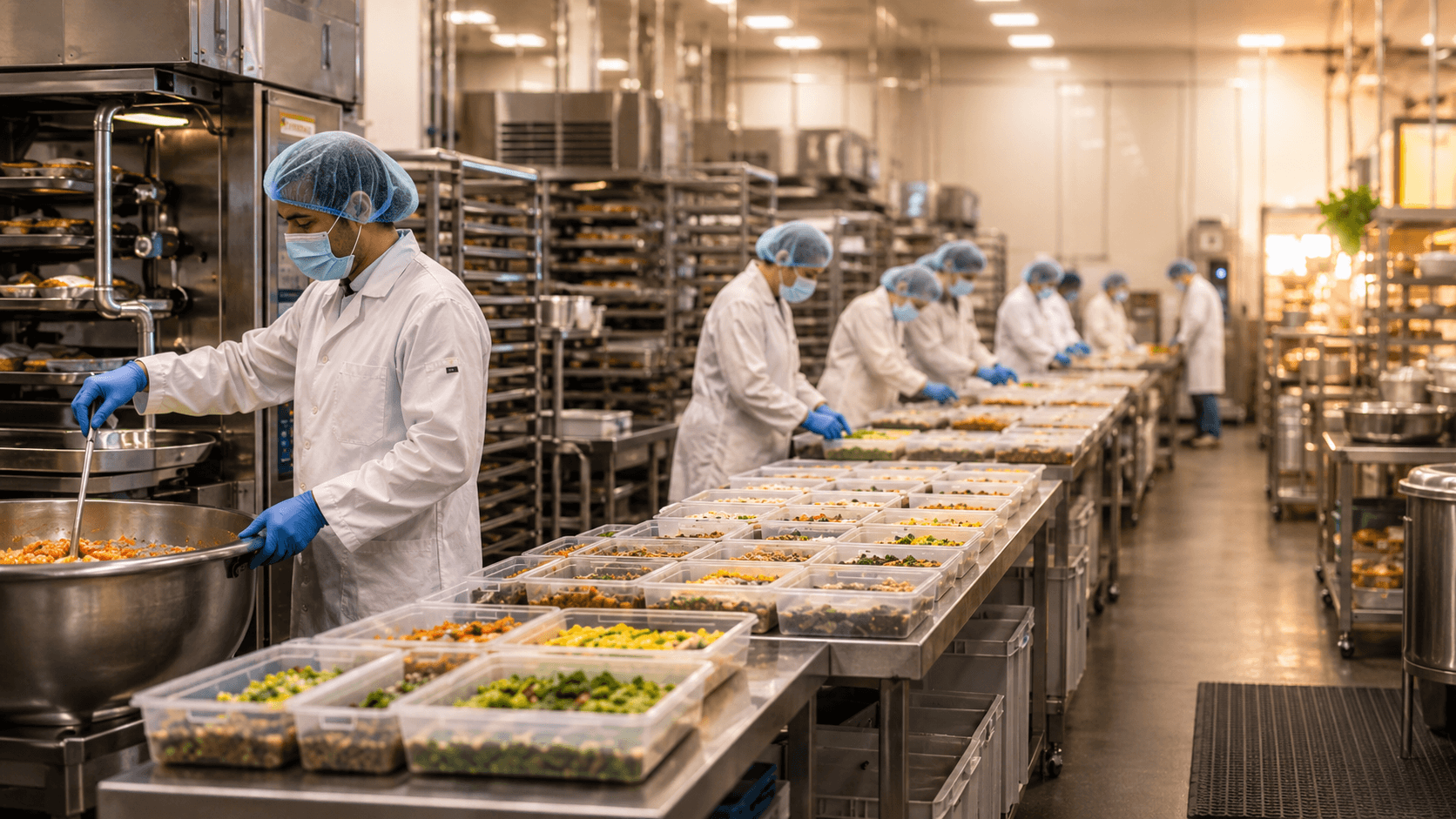
There’s a particular kind of headache that hits once a food business starts to outgrow its space. Demand’s strong, orders are stacking up, but you’ve literally run out of room to make the stuff. The obvious next step, buying or building a new freehold facility, can feel less like a solution and more like signing up for a new mortgage you never asked for.
If that sounds familiar, you’re not alone, and you’re certainly not boxed into that one option. Flexible CPUs – central production units you can scale into without owning the building – have quietly become the smarter way out for a lot of manufacturers and big brands facing the same growing pains.
Here’s why that shift matters.
The Freehold Trap
Buying property to fix a capacity problem is a bit like buying a house because you need somewhere to store your bike. Technically, it works, but it’s a colossal, slow-moving commitment for what is often a fairly specific, sometimes temporary, need.
New freeholds tie up capital that could be driving product development, marketing, or actual growth. They come with long lead times – planning permission, fit-out, compliance sign-off – often twelve to eighteen months before a single tray of product rolls off the line. And once you’ve bought it, you’re locked in, whether demand keeps climbing or levels off six months later.
Flexible CPUs sidestep all of that. You get the production capacity, the commercial kitchen infrastructure and the cold storage space, all without the capital outlay or the multi-year commitment that comes with owning bricks and mortar.
What “Flexible” Actually Means Here
“Flexible” gets thrown around a lot in commercial property without much substance behind it. Growth shouldn’t feel like a gamble. When demand spikes, the goal isn’t to bet the business on a building. It’s to keep momentum without losing sleep over construction timelines and capital lock-ins.
Flexible CPUs make that possible. They give you the infrastructure to scale production fast, test new product lines or expand into new regions, all without the drag of property ownership. They mean shorter, more adaptable lease terms rather than a decade-long commitment. You can dial capacity up or down as seasons shift, markets change, or new contracts land.
It’s the kind of agility that turns growth from a logistical headache into a strategic advantage.

Why Ownership Isn’t the Flex You Think It Is
There’s a long-standing assumption in food manufacturing that owning your own production facility is the mark of a “serious” operation. We think it’s worth pushing back on that a bit.
Owning a site ties up capital in an asset that, unless you’re in property as well as food, isn’t actually your business. It becomes a dead weight on the balance sheet if demand shifts. And it locks your capacity at whatever size made sense the day you signed, no matter how the market moves over the next five or ten years.
A flexible CPU model flips that logic. Your production footprint can track your real demand curve. Scaling up for a major retail contract or a seasonal surge doesn’t mean breaking ground on a new build – it means expanding within an existing setup. And when things settle, scaling back doesn’t leave you with an empty facility and a mortgage to service.
Stay serious about growth the smarter way, without being weighed down by ownership.
The Capital You Free Up
This is the part that tends to land hardest with finance teams, and fairly enough.
Every pound that isn’t tied up in freehold property or a bespoke fit-out is a pound available for the things that actually move a food brand forward. And that might be product development, marketing spend, sales team growth, or simply a healthier cash reserve, whatever the next eighteen months throws at you.
Manufacturers who go the flexible CPU route often find they can reinvest that freed-up capital directly into growth, rather than watching it sit in a building. It’s worth checking what commercial kitchens for rent actually cost before assuming flexible space is a stretch. For most manufacturers, it’s considerably more affordable than the capital a freehold ties up. It’s not a glamorous point, but it’s usually the one that gets a proposal signed off.
Speed to Production Matters More Than People Admit
Here’s something that doesn’t get discussed enough: the businesses that win in food manufacturing right now are often the ones that can move fastest, not necessarily the ones with the biggest facilities.
A new freehold facility can take well over a year from decision to production-ready. A flexible CPU space, by contrast, can typically be up and running in a fraction of that time, because the infrastructure, cold storage, compliance groundwork, the practical bones of a working production site, is largely already there.
For a brand trying to capitalise on a retail listing, respond to a spike in demand, or simply get a new product to market before a competitor does, that difference in lead time isn’t trivial. It can genuinely be the difference between capturing an opportunity and watching someone else get there first.
Cold Storage: Still the Sticking Point
It comes up again and again with growing food businesses, and manufacturing is no exception. Cold storage capacity is very often the actual bottleneck, even when everything else about a production plan looks solid.
Manufacturing at any real scale usually means holding significant volumes of chilled or frozen stock, and that requires proper, purpose-built cold storage, not a couple of extra chest freezers bolted onto a production line as an afterthought. Flexible CPU space that includes appropriately sized cold storage from the outset removes one of the most common reasons scaling plans stall.
Who This Actually Suits
Flexible CPUs aren’t just for businesses too small to justify their own facility. That’s a fairly outdated read. Established manufacturers and big brands use this model too, particularly when they’re testing a new product line, entering a new region, managing seasonal volume swings, or simply not ready to commit capital to a freehold while demand is still settling into a predictable pattern.
Dark kitchen operators, delivery brands, and caterers with fluctuating volume needs tend to be a particularly good fit, since the flexibility to scale space up and down maps directly onto how unevenly their demand actually moves.
Making the Switch Without the Stress
Moving from long-lease facility or production setup that’s maxed out, into a flexible CPU model doesn’t have to mean disruption. The key is finding a provider who can offer genuinely adaptable terms alongside cold storage and production space that’s actually suited to manufacturing volumes, rather than space repurposed from something else and hoped to work. Taking a look at our locations across London is a sensible starting point for working out what fits your distribution and supply chain needs.
When a food business is ready to scale, centralising prep, packing and dispatch in one unit removes the chaos of running five half-kitchens. Structure is what a CPU actually sells.
Nimesh Sachdev, Founder, Dephna
Getting that right from the start saves you from ending up in a smaller version of the same problem. Outgrowing the space again within a year and having to go through the whole search once more.
Final Thought
Capacity constraints are a genuinely good problem to have, in the sense that they mean demand exists. But solving them by defaulting to a new freehold isn’t always the smartest move. And for a lot of manufacturers and big brands, it’s not even the fastest one anymore.
Flexible CPUs offer a way to scale production capacity that actually tracks your business, rather than locking you into a decision made under pressure at a single point in time.
Dephna offers flexible commercial kitchen and cold storage space across London, designed to give growing food businesses room to scale without the commitment of a new freehold. If you’d like to talk through what flexible production capacity could look like for your brand, we’re happy to have that conversation. Contact our team today.
FAQs
What is a flexible CPU? A flexible CPU (central production unit) is dedicated commercial production and cold storage space that businesses can scale up or down as needed, without owning the freehold or committing to a long-term lease.
How is a flexible CPU different from buying a facility outright? Buying a facility means a large capital outlay, a lengthy setup process, and a fixed footprint. A flexible CPU offers production capacity on more adaptable terms, without tying up capital in property.
Who typically uses flexible CPU space? Manufacturers, big food brands, cloud kitchens, delivery brands, and caterers all use this model, particularly when demand fluctuates seasonally or during product launches and expansion.
How quickly can a business move into a flexible CPU? Considerably faster than a new freehold facility in most cases, since the core infrastructure – including cold storage and compliance groundwork – is typically already in place.
Does a flexible CPU include cold storage? Good flexible CPU providers include properly sized cold storage as standard, since this is often the biggest capacity constraint for growing manufacturers.
Is a flexible CPU only suitable for smaller or newer businesses? No. Established manufacturers and larger brands use flexible CPU space too, particularly when testing new products, entering new markets, or managing demand that varies through the year.
Can I scale a flexible CPU arrangement down again if demand drops? Yes, that’s the core advantage over ownership. Space can typically be scaled back without the ongoing cost burden of an owned facility sitting underused.
Why does capital efficiency matter when choosing a production model? Freeing up capital that would otherwise be tied up in property allows it to be reinvested into product development, marketing, or growth, rather than sitting in a building.
Is London a good location for flexible CPU space? Yes, particularly for brands needing efficient distribution across the city and wider South East, where proximity to customers and retail partners matters for logistics.
How do I know if my business needs a flexible CPU rather than its own facility? If you’re facing capacity constraints, uncertain or seasonal demand, or simply don’t want capital tied up in property at this stage, a flexible CPU is usually the more practical route.
Author Information:
This article was co-written by…
Raj, Managing Director
Raj is a Managing Director, bringing years of expertise in the food and commercial kitchen rental industry. With a focus on innovation and a deep understanding of business operations, Raj is committed to providing tailored solutions that help food entrepreneurs and start-ups succeed. Outside of work, Raj stays inspired by keeping up with the latest food industry developments.