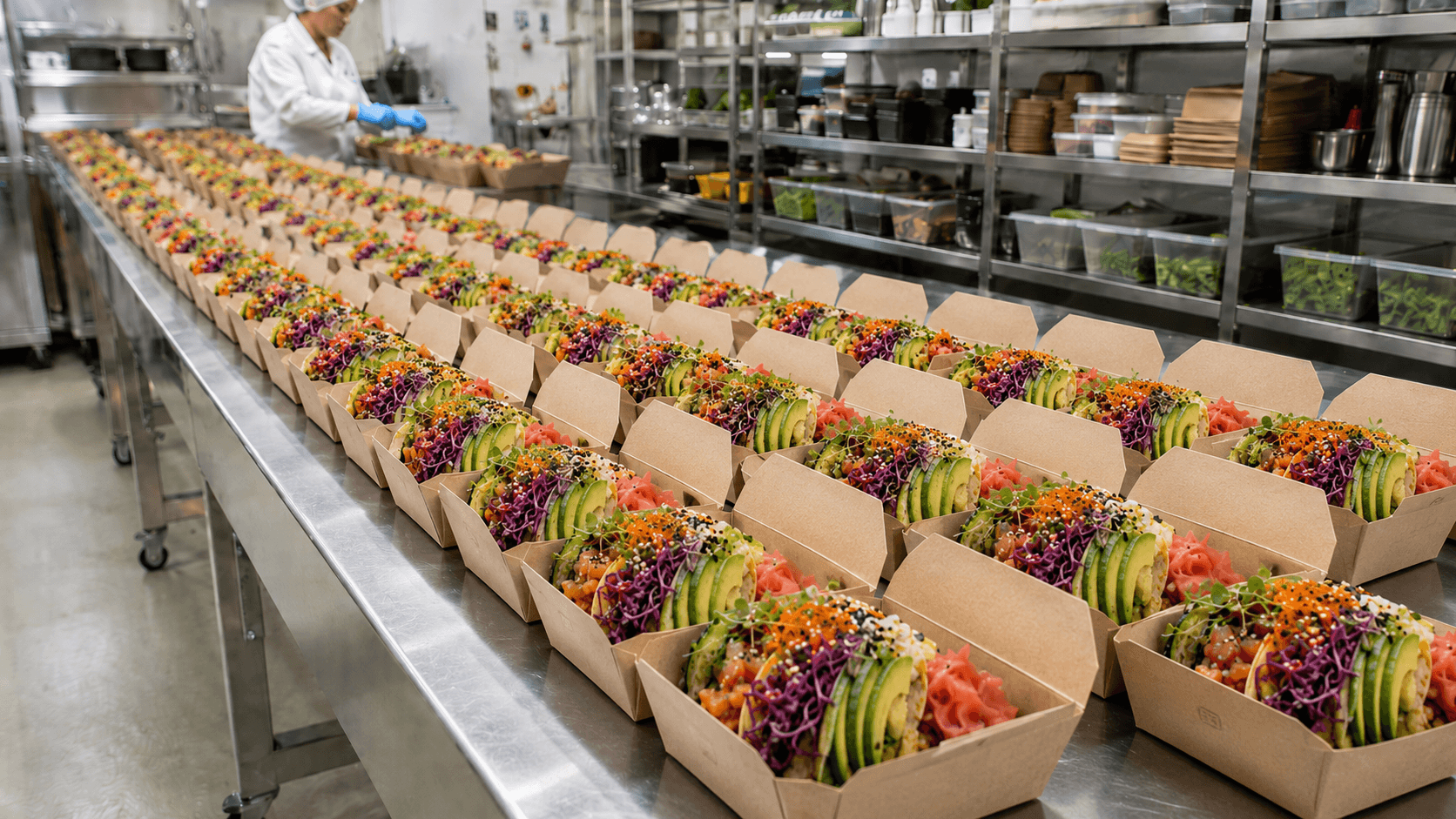
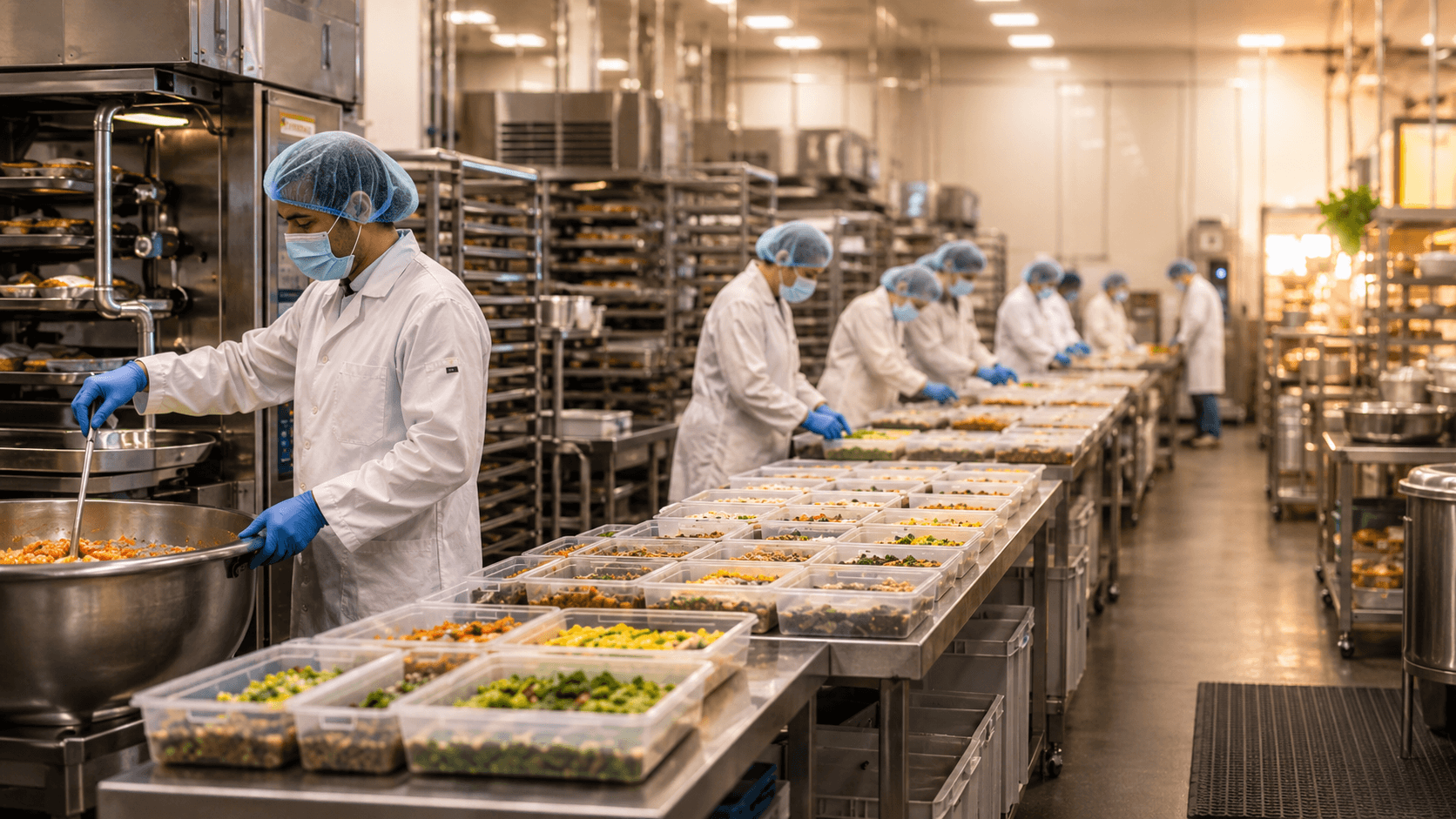
For growing food brands, the question is rarely whether a central production unit makes sense. It is usually when, where, and how much it will really cost.
Once production starts stretching your existing kitchen, margins get squeezed by inefficient prep, duplicated labour, fragmented storage, and delivery complexity. A well-planned central production unit can solve that by bringing prep, batching, packing, chilling, and dispatch into a single location, helping you ensure consistency, protect high quality, reduce food waste, and keep output consistently high across multiple sites.
But in London, cost is the sticking point.
The good news is that scaling production does not have to mean paying Central London occupancy costs. Industrial and logistics supply across London and the South East improved through 2025, with Inner M25 vacancy also rising, which matters because it gives food businesses more room to look beyond prime central locations for better-value space.
This guide breaks down what a central production unit cost in London typically looks like, where the money goes, and how to think about the all-important build vs rent decision.
What is a Central Production Unit?
A central production unit is a dedicated food production space used to prepare, cook, chill, pack, and distribute food from one single location to multiple delivery kitchens, retail sites, stores, caterers, or customer channels.
You might also hear them called:
- central production unit
- central production units CPU
- central production kitchens
Whatever label you use, the goal is the same: create a more cost effective operating model that improves throughput, strengthens product consistency, and makes it easier to deliver a consistently high standard across every outlet.
For chains, meal prep brands, FMCG challengers, and scaling SMEs, a CPU often becomes the backbone of growth.
Why Brands Move into a CPU
The move usually happens when one or more of these pressure points show up:
- Site kitchens are spending too much time on prep instead of finishing and service
- Product quality varies between locations
- Waste is rising because teams are over-ordering or prepping inconsistently
- Storage is fragmented across multiple sites
- Labour costs are creeping up due to duplicated roles
- You need stronger systems to satisfy retail, wholesale, or audit requirements
A central production model helps ensure consistency because recipes, processes, QA checks, portioning, and dispatch all sit under one roof. It can also cut food waste by improving forecasting, batch planning, stock rotation, and yield control. That is the operational upside.
For brands already thinking beyond their next site, it is worth understanding what scaling up a central production unit looks like in practice as production volumes, teams, and distribution needs grow.

The Headline Answer: How Much Does a Central Production Unit Cost in London?
For most growing food businesses, a London CPU will usually fall into one of three broad budget bands:
1. Lean rented CPU model
Approx. £80,000 to £250,000 upfront
Best for: growing SMEs testing a production model without heavy capex
This usually means taking a more functional outer-London or near-London industrial unit and fitting it out selectively, rather than building a high-spec manufacturing environment from scratch.
2. Mid-scale branded CPU
Approx. £250,000 to £750,000 upfront
Best for: established multi-site brands, meal prep operators, regional wholesale growth
This typically includes better production flow, larger chilled storage, improved extraction, more specialist kit, packing infrastructure, and a higher compliance standard.
3. Purpose-built high-output CPU
£750,000 to £2m+ upfront
Best for: chains, high-volume meal prep, retail supply, complex chilled/frozen production, FMCG manufacture
This is where costs rise fast: more engineering, more drainage, more power upgrades, larger cold rooms, more robust segregation, higher-spec finishes, more technical compliance, and often more consultant involvement.
Those numbers vary by size, condition of the building, M&E requirements, and how close you want the site to inner London demand.
The Biggest Cost Categories in a London CPU
A CPU budget is not just “rent plus equipment”. The real cost sits across several layers.
1) Property: Rent, Deposit, Legal Fees, Fit-Out Constraints
London industrial and logistics markets are still expensive compared with many UK regions, but tenant conditions have eased compared with the tightest post-pandemic period. Savills reported London and South East supply at 12.7 million sq ft by the end of 2025, with the Inner M25 vacancy rate at 8.42%.
That matters because for food businesses, the most sensible CPU location is often outside Central London, where you can still reach your customers while avoiding prime central occupational costs.
Typical annual rent range
For a functional food production unit in outer London / Inner M25 locations, you may see rents broadly in the region of:
- £15 to £35+ per sq ft depending on spec, access, power, and exact location
- Higher for newly refurbished, better-performing industrial assets
- More again if the landlord has already delivered heavy works or specialist fit-out
As a rough example:
- 2,500 sq ft unit at £22/sq ft = £55,000/year
- 5,000 sq ft unit at £22/sq ft = £110,000/year
- 8,000 sq ft unit at £25/sq ft = £200,000/year
Add these property-related upfront costs
- Rent deposit: often 3–6 months
- Legal fees
- Surveyor fees
- Licence to alter / landlord approvals
- Possible reinstatement obligations at lease end
- Service charge, if applicable
This is one reason renting looks cheaper on paper than it feels in practice.
2) Business Rates
From 1 April 2026, England’s non-domestic rating system applies updated multipliers following revaluation. GOV.UK notes that business rates depend on rateable value and property type, and the 2026–27 tax year introduces updated multipliers.
For CPU budgeting, the practical point is simple: do not ignore rates.
A modest industrial food unit can easily face a meaningful annual business rates bill, especially as size and location improve. Even if your rent feels manageable, rates can materially change total occupancy cost.
For many operators, a realistic rule of thumb is to budget roughly 25% to 45% of headline rent again for rates, then verify the actual rateable value on the target unit before signing.
3) Fit-Out and Building Works
This is where CPU budgets diverge sharply.
A standard light industrial shell is not automatically food-production-ready. A genuine CPU may need:
- Hygienic wall and ceiling finishes
- Resin or sealed flooring
- Floor drainage
- Grease management
- Wash-up zones
- Extraction and ventilation
- Gas and electrical upgrades
- Additional water supply points
- Segregated production flow
- Dispatch and packing areas
- Pest-proofing
- Fire safety works
- Staff welfare areas
- Compliance-led layout planning
General fit-out benchmarks vary hugely, but commercial fit-outs can already run high even before food-production-specific works are added. Savills highlighted one landlord fit-out package at £200 per sq ft on a London property, while RIBA project examples show build costs in the low-thousands per m² on non-food projects. Those are not direct CPU comparables, but they underline how quickly costs climb once significant works are involved.
Sensible budgeting range for CPU fit-out
For planning purposes:
- Light adaptation: £30 to £80/sq ft
- Mid-level CPU fit-out: £80 to £150/sq ft
- Heavy production-grade fit-out: £150 to £250+/sq ft
So a 3,000 sq ft CPU might require:
- £90,000 to £240,000 for lighter adaptation
- £240,000 to £450,000 for a stronger mid-spec build
- £450,000 to £750,000+ for high-spec food production works
This is why the condition of the incoming unit matters so much. Taking a space that already has suitable services, drainage, or prior food use can save a substantial amount.
4) Equipment and Production Infrastructure
Your equipment budget depends on whether the CPU is mostly prep and dispatch, or a full cook-chill / cook-freeze / packing operation.
Typical categories include:
- Combi ovens / rack ovens
- Bratt pans / kettles
- Mixers
- Blast chillers
- Extraction systems
- Walk-in cold rooms and freezer rooms
- Stainless prep benches
- Racking
- Packing lines
- Sealing / labelling kit
- Washing equipment
- Trolleys and transport containers
- Temperature monitoring systems
Commercial refrigeration suppliers now publish energy and cost calculators based on business electricity rates, which is useful for lifecycle planning, not just purchase cost.
Broad equipment budget guide
- Lean setup: £40,000 to £120,000
- Mid-scale CPU: £120,000 to £350,000
- Large or specialist CPU: £350,000 to £1m+
Cold storage rooms alone can become a major line item, especially if you need separate raw, finished product, allergen, or frozen zones.
5) Utilities and Energy
Energy is one of the most underestimated CPU costs.
Refrigeration, extraction, cooking, blast chilling, hot water, and packing all push utility spend upward. Ofgem’s business research found most small and medium businesses reported electricity as less than 10% of total costs, but for energy-intensive food production spaces, utilities can still become a major controllable overhead.
Typical utility considerations
- Three-phase power availability
- Capacity upgrades
- Standing charges
- Peak load from refrigeration and cooking equipment
- Water use
- Drainage and trade effluent considerations
- Preventative maintenance on plant
A realistic planning assumption for a modest CPU is often £2 to £6 per sq ft annually in utilities, though complex chilled or cooked operations can land higher.
6) Waste and Food Waste Management
In a proper CPU, waste is not just a hygiene issue. It is a margin issue.
The more centralised your production, the easier it becomes to measure trim loss, overproduction, packaging waste, and spoilage from one point. That is one reason CPUs can be more cost effective than fragmented site-by-site prep.
London borough commercial waste charges vary, but public schedules show costs can add up quickly. For example, Richmond’s 2025/26 commercial charges list £503/year for a 240L residual bin and £1,524/year for an 1100L residual bin; Wandsworth’s published charges for one collection per week also show meaningful annual costs across bin sizes.
Budget guide
For a small-to-mid CPU, allow roughly:
- £3,000 to £15,000+ per year for waste and recycling
- More if collections are frequent, packaging-heavy, or food waste volumes are high
The upside is that a well-run CPU can materially reduce food waste through tighter forecasting and production controls.
7) Compliance, food safety, and audit readiness
This is the area too many operators under-budget.
A CPU serving multiple locations usually needs stronger systems than a single restaurant kitchen. You may need:
- HACCP documentation
- Allergen controls
- Temperature monitoring
- Traceability processes
- Cleaning validation
- Supplier approval systems
- Calibration
- Pest control contracts
- Staff training
- External compliance support
- Retail-standard or third-party audit preparation
Food businesses must register with their local authority at least 28 days before trading, and registration is free.
If you are supplying retailers or larger wholesale customers, standards such as BRCGS Food Safety may also become commercially important because they provide a recognised framework for product safety, legality, and quality.
As production grows, having clear central production unit food quality standards in place becomes essential for protecting consistency, compliance, and customer trust.
Budget guide
- Basic compliance setup: £3,000 to £10,000
- More formal systems / audit prep: £10,000 to £40,000+
8) Insurance, people, and launch working capital
Insurance pricing varies widely by scale and cover, but even small food businesses can see annual premiums in the hundreds to low thousands. Simply Business example quotes show small food operations and catering-style businesses ranging from a few hundred pounds to over £900/year in sample scenarios, before scaling for larger premises and more complex risk.
Then there is working capital:
- Initial ingredients and packaging stock
- Recruitment and training
- Agency cover during launch
- Trial production runs
- Distribution setup
- Contingency
A CPU is not truly funded until you have covered the first few months of operating drag.
Build vs Rent: Which is Better?
This is the key strategic choice.
Renting a CPU
Pros
- Lower upfront capital
- Faster route to launch
- Easier to test the model
- More flexibility if production volumes change
- Better for SMEs still proving demand
Cons
- Lease constraints
- Landlord approval on alterations
- Reinstatement costs
- Ongoing rent escalation risk
- You are investing capex into someone else’s building
Building or buying your own CPU
Pros
- More control over layout and workflow
- Better long-term asset logic at scale
- Easier to tailor for compliance and throughput
- Potentially better economics over a longer horizon
Cons
- Much higher upfront spend
- Longer timeline
- More consultant and planning complexity
- Greater risk if volumes do not materialise
A Practical Rule
For most growing SMEs, rent first is usually the smarter move.
For larger chains, established meal prep brands, and high-volume producers with stable demand, a more permanent build or acquisition case starts to make sense.
Sample CPU Budget Planner
Here is a realistic example for a 4,000 sq ft rented CPU in outer London:
Option A: Lean rented CPU
- Deposit and legal: £20,000–£40,000
- Initial fit-out: £120,000–£220,000
- Equipment: £60,000–£140,000
- Compliance and setup: £5,000–£15,000
- Launch working capital: £30,000–£75,000
Estimated upfront total: £235,000–£490,000
Annual ongoing costs
- Rent: £70,000–£110,000
- Rates: £20,000–£45,000
- Utilities: £12,000–£30,000
- Waste: £4,000–£10,000
- Insurance, pest control, maintenance, compliance: £8,000–£25,000
Estimated annual operating overhead before labour and ingredients:
£114,000–£220,000
Option B: Higher-spec CPU
- Deposit and legal: £25,000–£50,000
- Fit-out: £280,000–£520,000
- Equipment: £180,000–£400,000
- Compliance and audit readiness: £15,000–£40,000
- Launch working capital: £50,000–£120,000
Estimated upfront total: £550,000–£1.13m
How to Keep CPU Costs Under Control
The smartest operators do not just hunt for cheap rent. They reduce total occupancy and production cost by making better decisions early.
The strongest CPU setups are the ones that balance efficiency with standards, which is why controlling costs and quality in a central production unit needs to be part of the plan from day one.
1. Stay out of Central London where possible
You do not need a Zone 1 postcode to serve London. A well-positioned outer-London or NW London production base can dramatically improve the maths.
2. Take the right space, not the biggest space
Unused square footage is expensive. A tighter, well-planned CPU often beats an oversized, badly flowing unit.
3. Prioritise workflow over aesthetics
The money should go into drainage, refrigeration, extraction, segregation, and dispatch logic, not showroom finishes.
4. Design for product consistency
A CPU only pays off when it helps ensure consistency and hold high quality across every batch and every site.
5. Build waste control in from day one
A CPU can reduce food waste, but only if batch sizing, stock rotation, labelling, and demand planning are disciplined.
Where Dephna Fits In
For many brands, the biggest mistake is treating a CPU like a generic warehouse with some catering kit added in.
It is not.
A good CPU needs to be operationally practical, scalable, and compliance-ready from the start. That means thinking through production flow, storage, hygiene zoning, dispatch, staffing, and audit expectations before costs spiral.
That is also why many brands look beyond Central London and towards better-value locations that still keep them close to their customer base. For businesses that want to scale without Central London cost, access the right type of commercial kitchen infrastructure, and move into a more structured production model, the right space strategy matters just as much as the rent itself.
Dephna supports food businesses at different stages of growth with flexible commercial kitchen and production space solutions designed around real operational needs. For brands moving towards a CPU model, that can mean choosing a more practical location, reducing unnecessary fit-out costs, and creating a setup that supports growth, quality control, and compliance from one base.
What This Means for Growing Food Brands
So, how much does a central production unit cost in London?
For most brands, the real answer is:
- A lean rented CPU can start from the low six figures
- A solid mid-scale setup often lands in the mid six figures
- A high-output, compliance-heavy CPU can move comfortably into seven figures
The right number depends less on ambition and more on how smartly the space is chosen and scoped.
If your goal is to improve output, reduce food waste, maintain product consistency, and ensure consistency across multiple channels from a single location, a CPU can be one of the most effective investments you make.
But only if the cost model is built around the business you have now and the one you realistically want to become next.
FAQs About Central Production Unit Costs in London
A central production unit in London can range from the low six figures for a smaller rented setup to much higher for larger, specialist operations. Costs usually depend on size, location, fit-out, equipment, and compliance needs.
For most growing SMEs, renting is usually more affordable upfront and gives more flexibility. Building or buying can make sense at larger scale, but it requires far more capital and a longer setup period.
Food businesses use central production units to improve efficiency, reduce duplicated prep, and ensure consistency across multiple sites. It also helps protect high quality and improve product consistency from a single location.
Yes. A CPU can help reduce food waste by centralising forecasting, prep, stock control, and portioning. That usually means better yield, less duplication, and tighter margin control.
A CPU budget should include rent, deposit, fit-out, equipment, utilities, waste, insurance, compliance, and working capital. Fit-out and services are often the biggest hidden costs.
No. Many brands use a CPU model to scale without Central London cost. An outer-London location can often offer much better value while still serving London efficiently.
A central production kitchen can work well for restaurant groups, meal prep brands, caterers, bakeries, and FMCG food businesses. It is especially useful when production is growing across multiple sites.
Usually, when site kitchens are becoming too full, prep is taking over service space, or consistency is harder to maintain. If production is spread across too many kitchens, a CPU can create a more scalable setup.
Sources
Savills logistics market updates for London and the South East
GOV.UK business rates and food business registration guidance
Commercial waste charges published by London boroughs
Ofgem business energy research
BRCGS and LRQA food safety guidance
Author Information
This article was co-written by…
Brindha, Sales Director
Our Sales Director, Brindha, knows her stuff when it comes to finding the perfect commercial kitchen or cold storage solution. With years of experience and a hands-on approach, she’s all about making life easier for food entrepreneurs so they can focus on what they do best – creating amazing dishes. When she’s not helping businesses thrive, Brindha’s out and about exploring the hottest food trends around London.