
For a growing food business, success can create a slightly awkward problem.
Across the UK, more restaurant groups, delivery brands, caterers and food operators are moving parts of their prep away from individual sites and into dedicated production kitchens. Not necessarily because restaurant kitchens are failing. More often, it is because they are being asked to do too much.
The more sites you open, the harder it becomes to make every dish taste the same, arrive at the same standard, and be produced with the same level of efficiency. What worked beautifully in one restaurant kitchen can start to feel messy across five, ten or twenty locations.
That is where the central production unit, or CPU, comes in.
A CPU can take the pressure off. It can support consistency, improve stock control, make better use of labour and help brands scale without turning every restaurant kitchen into a mini factory.
So, what is the difference between a CPU and a restaurant kitchen? Why are chains centralising prep? And how does it actually work in practice?
What Is A CPU In Food Production?
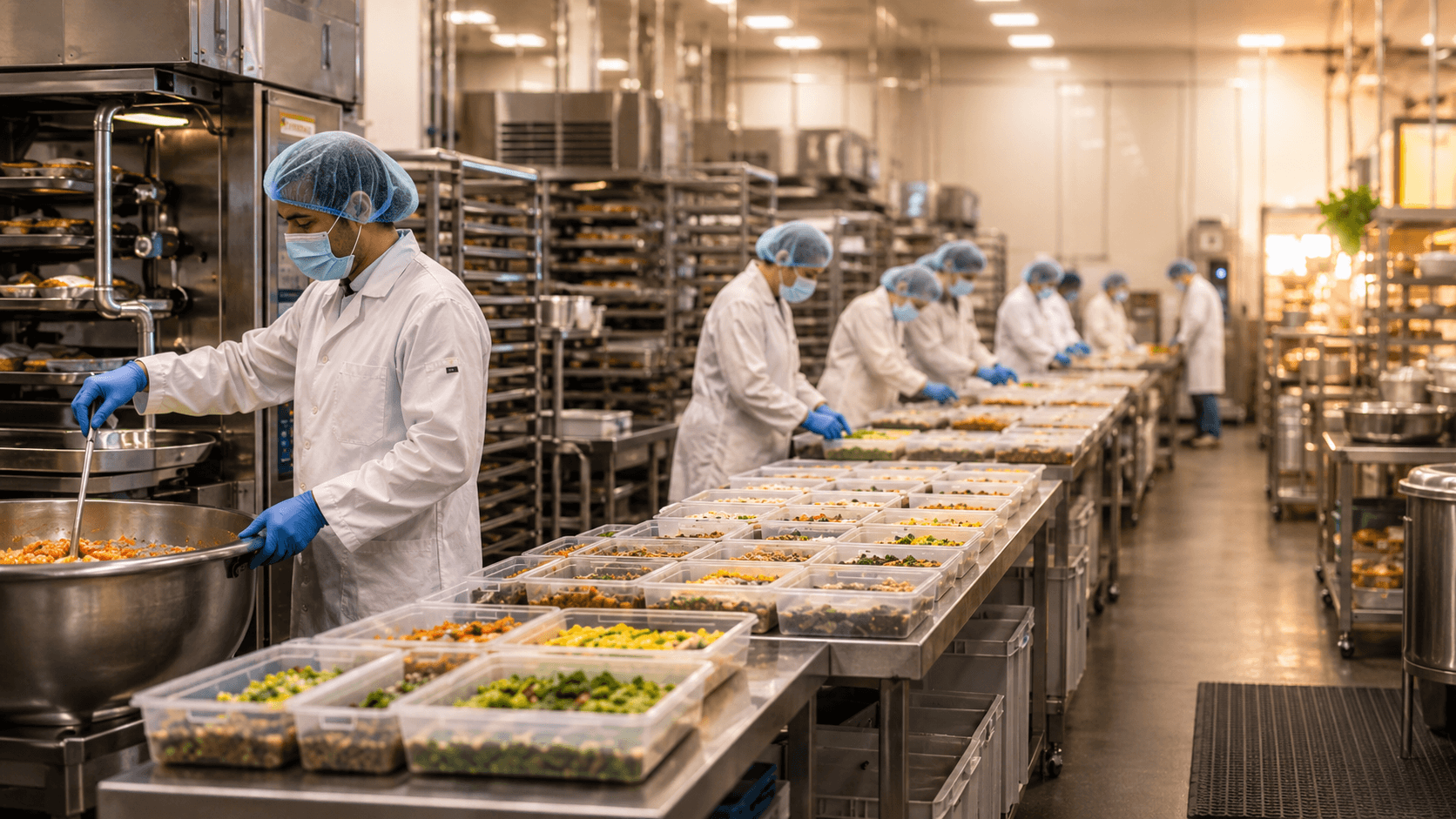
A CPU, or central production unit, is a dedicated kitchen or food production space where ingredients, components or finished products are prepared centrally before being sent out to other locations.
That might include:
- Sauces, stocks and marinades
- Prepped vegetables
- Doughs, batters and bakery items
- Cooked proteins
- Ready-to-heat meal components
- Desserts
- Packaged products
- Chilled or frozen items
- Grab-and-go food
- Event catering prep
In simple terms, a CPU handles the repeatable prep that does not always need to happen at each individual restaurant, café, delivery kitchen or retail site.
For some food businesses, the CPU produces complete dishes. For others, it prepares key components so site teams can finish, assemble or serve them locally.
There is no one-size-fits-all model. A bakery brand, a burger chain, a premium ready meal company and a catering group might all use a CPU very differently.
The shared goal is usually the same: better control.
What Is A Restaurant Kitchen Designed To Do?
A restaurant kitchen is typically built around service.
Its main job is to prepare, cook, finish and plate food for customers in real time. Even in a delivery-led restaurant, the kitchen is still usually focused on live orders, speed, quality and the rhythm of service.
A restaurant kitchen needs to handle:
- Mise en place
- Cooking to order
- Finishing dishes
- Plating or packing
- Managing service peaks
- Cleaning down between shifts
- Stock rotation
- Delivery or customer order flow
That is already a lot.
When a restaurant kitchen is also expected to produce sauces for the whole group, prep ingredients for other branches, portion and pack products, manage bulk deliveries and store extra chilled stock, things can get crowded quite quickly.
This is often the point where centralising prep starts to look less like a luxury and more like a practical next step.
CPU Vs Restaurant Kitchen: What Is The Difference?
The main difference is purpose.
A restaurant kitchen is designed for service. A CPU is designed for production.
That affects almost everything, from layout to staffing to storage.
Restaurant Kitchen
A restaurant kitchen is usually close to customers and built around immediate output. It prioritises speed, finishing, service flow and guest experience.
The team is often working to short windows of intense demand. Lunch rush. Dinner rush. Delivery peak. Saturday night chaos. You know the drill.
Central Production Unit
A central production unit is usually built around batch preparation, repeatable processes and onward distribution.
The team may be producing high volumes of the same components, following standardised recipes, portioning products, labelling stock and preparing items for chilled or frozen storage before dispatch.
A CPU is less about “table six needs this now” and more about “we need 400 litres of sauce ready, chilled, labelled and distributed by tomorrow morning.”
Less theatre. More systems.
And for scaling food brands, that can be a very good thing.
Why Are Chains Centralising Prep?
Centralising prep is not a new idea. Large food manufacturers and national chains have used central production models for years.
What has changed is that mid-sized restaurant groups, cloud kitchen operators, caterers and ambitious food startups are now looking at CPU models much earlier in their growth journey.
There are a few reasons for that.
1. Better Consistency Across Multiple Sites
Consistency is one of the biggest reasons food chains move prep into a CPU.
When every site is making the same sauce, marinade, dough or dessert from scratch, small differences are almost inevitable. One chef reduces a sauce slightly more. Another uses a different technique. One site is short-staffed and rushes prep. Another has a more experienced team.
Individually, these differences might seem minor. Across a growing estate, they can dilute the brand experience.
A CPU helps standardise key components so each site starts from the same base. Recipes, portion sizes, cooking methods and quality checks can all be managed centrally.
For customers, that means the dish they enjoyed in Shoreditch should taste the same in Richmond, Hackney or Streatham.
For the business, it means less reliance on every site interpreting the same recipe perfectly every time.
2. Less Pressure On Restaurant Kitchens
Restaurant kitchens are often tight on space. That is especially true in London, where square footage rarely comes cheap and back-of-house areas can feel like an afterthought.
If a site team is trying to prep high volumes during quiet hours, they may still be competing for space with deliveries, cleaning, staff meals, service setup and daily operations.
Centralising prep can free up restaurant kitchens to focus on what they are best at: service.
That can mean:
- Less cluttered prep areas
- Shorter mise en place lists
- Reduced pressure before service
- Fewer bulk ingredients stored on site
- More efficient shift planning
- More space for finishing and packing orders
It is not glamorous. But neither is trying to portion 40 kilos of onions in a cramped corner next to the pot wash.
3. Improved Labour Efficiency
Skilled kitchen labour is valuable. It is also under pressure across the UK hospitality sector.
When every site repeats the same prep tasks, labour can be duplicated. Multiple teams may be making the same base sauces, chopping the same vegetables or preparing the same components in smaller, less efficient batches.
A CPU can consolidate those tasks.
Instead of five sites each spending time on the same prep, one central team can produce larger batches with clearer processes and more predictable schedules.
This does not remove the need for skilled chefs. It simply uses their time differently.
Site teams can spend more time on finishing, quality control, customer experience and service. CPU teams can focus on batch production, consistency, technical accuracy and safe storage.
For many chains, that split makes commercial sense.
4. Stronger Stock Control And Purchasing
A central production kitchen can make purchasing and stock control much easier to manage.
Rather than each location ordering its own ingredients independently, the business can buy more centrally, control specifications and reduce variation between suppliers.
This can help with:
- Bulk purchasing
- Waste reduction
- Ingredient consistency
- Stock forecasting
- Allergen control
- Supplier management
- Traceability
- Storage planning
For food businesses with several sites, this is often where the CPU starts to prove its value behind the scenes.
Better visibility over stock means fewer surprises. Fewer emergency top-up orders. Fewer mystery boxes sitting in the walk-in fridge with a date label that has seen better days.
5. Better Use Of Cold Storage
Centralising prep often goes hand in hand with better cold storage.
A CPU gives businesses more control over how products are cooled, stored, labelled and dispatched. This is particularly useful for brands handling high volumes of prepared components or frozen products.
Depending on the operation, a CPU may need:
- Chilled storage
- Frozen storage
- Ingredient storage
- Finished goods storage
- Blast chilling access
- Clear segregation by product type
- Allergen-aware storage systems
- Space for dispatch staging
For delivery brands, caterers and packaged food businesses, cold storage can quickly become one of the biggest operational bottlenecks.
A restaurant fridge is not always the right place to hold production stock for several sites. It might work for a while, but once volumes increase, it can start to affect workflow, food safety and stock rotation.
A CPU with suitable cold storage gives the operation more breathing room.
6. Easier Menu Rollouts And Product Development
Rolling out a new menu item across multiple sites can be surprisingly complex.
Every kitchen needs the recipe. Every team needs training. Every supplier needs to deliver the right ingredients. Every site needs to hit the same standard.
A CPU can simplify that process by producing the key components centrally.
This allows brands to:
- Test recipes at production scale
- Control portioning and specifications
- Reduce variation between sites
- Launch new items more smoothly
- Support seasonal menu changes
- Train site teams on finishing rather than full production
For ambitious food brands, this can be a major advantage. Product development becomes more controlled, and site teams are not left trying to work out a new dish during a busy Friday evening.
No one enjoys that.
7. More Scalable Operations
At one site, informal systems can work. People know where everything is. The head chef has the recipes in their head. The team can adapt.
At ten sites, that becomes risky.
Scaling needs structure. Not heavy bureaucracy, but clear processes that are easy to repeat.
A central production unit can create that structure. It gives growing food businesses a base for production, storage, quality control and distribution.
That can be especially useful for:
- Restaurant groups expanding to new locations
- Caterers managing larger events or contracts
- Delivery brands operating across several zones
- Food startups moving into wholesale or retail
- Cloud kitchen operators running multiple concepts
- Brands launching packaged chilled or frozen ranges
The CPU becomes the operational backbone. Not always visible to the customer, but essential to keeping the brand running smoothly.

How Does A CPU Work In Practice?
The details vary depending on the business, but a typical CPU model follows a fairly clear flow.
Step 1: Centralised Ordering And Stock Intake
Ingredients are ordered into the CPU rather than every site receiving all raw materials separately.
Deliveries are checked, recorded and stored according to food safety procedures. This gives the business better control over supplier quality, traceability and stock levels.
For larger operations, this stage can involve dedicated goods-in areas, chilled intake checks and clear separation between raw, cooked, chilled and frozen products.
Step 2: Batch Preparation
The CPU team prepares products in batches according to standard recipes and production schedules.
This could include chopping, mixing, marinating, cooking, baking, cooling, portioning or packing.
The aim is not just to make food in volume. It is to make it consistently, safely and in a way that suits onward service.
A sauce, for example, may need to be cooked, chilled, portioned, labelled and delivered to sites in a format that is easy for chefs to use during service.
Step 3: Quality Checks
A well-run CPU should have quality control built into the process.
That may include checking:
- Recipe accuracy
- Batch weights
- Cooking temperatures
- Cooling times
- Labelling
- Allergen information
- Shelf life
- Packaging condition
- Product appearance and taste
Quality checks are a major reason chains centralise prep. If issues are spotted at the CPU stage, they can be corrected before products reach multiple sites.
Step 4: Chilled Or Frozen Storage
Once prepared, products are stored safely before dispatch.
Some items may be chilled for short-term use. Others may be frozen to extend shelf life and support more predictable stock management.
The right approach depends on the product, menu, delivery schedule and food safety requirements.
For businesses operating across London, chilled and frozen storage can be a critical part of making the CPU model work. Production is only useful if the finished product can be held safely and distributed efficiently.
Step 5: Distribution To Sites
Products are then sent to restaurants, delivery kitchens, retail units or event locations.
Some businesses deliver daily. Others work on a few scheduled drops per week. The frequency depends on product shelf life, site storage capacity, menu demand and transport logistics.
The best CPU models are built around realistic distribution. There is little point centralising prep if the products arrive late, damaged, incorrectly labelled or in quantities sites cannot store.
Step 6: Finishing At Site
Once products reach each location, site teams finish or assemble them as needed.
This might involve reheating, cooking to order, plating, adding fresh garnishes or packing for delivery.
The customer still gets freshly prepared food. The difference is that the labour-intensive or consistency-critical parts have already been handled centrally.
Done well, it should feel seamless.
What Types Of Food Businesses Benefit From A CPU?
A CPU can support many different types of food businesses, but it is particularly useful when a brand has repeatable production needs across multiple outlets or channels.
Restaurant Groups
Restaurant chains often use CPUs to prepare sauces, bases, desserts, marinades, doughs or high-volume prep items.
This helps protect consistency and reduce pressure on individual kitchens.
For brands with several sites, it can also make training and menu rollouts much easier.
Caterers
Catering businesses often need to produce large quantities of food for events, corporate contracts or regular clients.
A CPU can provide space for bulk prep, chilled storage, packing and dispatch.
It can also help caterers manage seasonal peaks without overwhelming smaller kitchens.
Delivery Brands And Cloud Kitchens
Delivery-led brands need speed, consistency and strong packaging workflows.
Centralising prep can help them supply multiple delivery sites with consistent components, reducing prep time at each location and supporting faster order fulfilment.
This is especially useful for brands running several virtual concepts or operating across multiple delivery zones.
Food Startups
For food startups moving beyond small-batch production, a CPU can be a stepping stone between home-style production and larger manufacturing.
It can support test runs, wholesale prep, chilled or frozen product development and controlled scaling.
Many startups reach a point where their original kitchen setup simply cannot keep up. A CPU gives them a more structured way to grow.
Packaged Food And Ready Meal Brands
Brands producing chilled or frozen meals, desserts, sauces or packaged products often need repeatable production space and reliable cold storage.
A CPU model can support batch production, portion control, labelling, freezing and dispatch.
For these businesses, the line between kitchen and production facility can become quite blurred. The right setup needs to support both food quality and operational control.
When Does It Make Sense To Move To A CPU?
A CPU is not necessary for every business. If you operate one site with a manageable menu and enough kitchen space, centralising prep may be more complexity than you need.
But it may be worth considering if:
- You have multiple sites making the same products
- Consistency varies between locations
- Your restaurant kitchens are running out of prep space
- Labour costs are rising due to duplicated tasks
- Cold storage is under pressure
- You are wasting stock across sites
- You are launching into wholesale or retail
- You need more control over allergens and traceability
- Menu rollouts are becoming difficult
- Site teams are spending too much time on prep rather than service
A useful question is: are your kitchens doing production work when they should be doing service?
If the answer is yes, a CPU may help.
What Are The Challenges Of Centralising Prep?
Of course, a CPU is not magic. It needs proper planning.
Some of the common challenges include:
- Setting up reliable production schedules
- Managing transport and delivery times
- Maintaining product quality after storage and distribution
- Training site teams to finish products correctly
- Forecasting demand accurately
- Controlling shelf life
- Managing allergens and labelling
- Keeping communication clear between CPU and sites
A CPU can solve many problems, but it can also create new ones if the processes are vague.
The most successful setups are usually the ones that start with a clear operational plan: what will be made centrally, how it will be stored, how often it will be delivered, and what each site is responsible for finishing.
Simple on paper. A bit more involved in real life.
But very achievable with the right space and systems.
CPU Vs Restaurant Kitchen: Which Is Right For Your Business?
This is not always an either-or decision.
For many chains, the answer is both.
The CPU handles the production-heavy, consistency-critical or storage-intensive tasks. The restaurant kitchen handles finishing, service and the customer-facing side of the experience.
A central production unit might make sense for:
- Base sauces
- Doughs and bakery items
- Desserts
- Cooked proteins
- Batch-prepped vegetables
- Frozen items
- Packaged products
- Stock-intensive components
A restaurant kitchen is better suited to:
- Cooking to order
- Final assembly
- Plating
- Fresh finishing touches
- Customer-specific requests
- Service-led decision-making
The balance depends on the brand. Some businesses centralise almost everything. Others only centralise a few high-volume components.
The smartest model is usually the one that removes pressure without making the food feel less fresh, less distinctive or less “yours”.
Key Takeaways For Growing Food Chains
Centralising prep is not about removing craft from the kitchen. It is about putting the right work in the right place.
A CPU can help food businesses:
- Improve consistency across sites
- Reduce pressure on restaurant kitchens
- Use labour more efficiently
- Strengthen stock control
- Improve chilled and frozen storage management
- Support menu rollouts
- Scale production in a more structured way
For UK food chains, caterers, delivery brands and startups, the central production unit is becoming a practical tool for growth.
Not every business needs one straight away. But once prep starts slowing down service, filling every fridge, or varying from site to site, it is probably time to look at the model properly.
Explore Flexible CPU, Kitchen And Cold Storage Options With Dephna
As food businesses grow, their kitchens often need to do more than they were originally designed for. More prep. More stock. More staff. More chilled and frozen storage. More pressure on every square metre.
A central production unit can help bring structure to that growth, giving teams a dedicated space for batch prep, production, storage and dispatch while allowing individual sites to focus on service.
For restaurant groups, caterers, delivery brands and food startups looking to centralise prep, Dephna offers flexible commercial kitchen and cold storage options in London.
Find a setup that supports your production, your workflow and your next stage of growth, with the on-site support you need to scale without the stress. Talk to our team today to be part of the Dephna family.
A meal prep kitchen is a commercial production space used to prepare, cook, portion, pack, label and store meals before they are delivered, collected or sold to customers.
If you are producing meals at scale, a commercial kitchen is usually the most practical setup. It gives you the space, workflow, hygiene controls and storage needed to prepare food safely and consistently.
Look for enough prep space, suitable cooking capacity, chilled and frozen storage, ventilation, cleaning facilities, packing space and easy dispatch access.
Cold storage is essential because meal prep businesses often need space for ingredients, work-in-progress food and finished meals.
A meal prep kitchen should have clear food safety procedures covering cooking temperatures, cooling times, chilled storage, allergen control, cleaning routines, pest control, stock rotation and dispatch. These should be documented and followed consistently.
Meal prep involves several stages, from ingredient delivery and batch cooking to cooling, portioning, labelling, storage and dispatch. A clear workflow helps reduce crossover, avoid delays and keep production more organised.
Author Information
This article was co-written by…
Raj, Managing Director
Raj is a Managing Director, bringing years of expertise in the food and commercial kitchen rental industry. With a focus on innovation and a deep understanding of business operations, Raj is committed to providing tailored solutions that help food entrepreneurs and start-ups succeed. Outside of work, Raj stays inspired by keeping up with the latest food industry developments.


