Growth should feel like a win. Orders are rolling in, the team’s flat out, and the delivery app keeps buzzing. So when margins take a downturn at exactly the moment sales are climbing, it’s understandable to wonder what’s going wrong.
Most operators know their rent to the penny. Far fewer know what it costs them that five head chefs make the same tomato sauce every Tuesday.
More often than not, the culprit isn’t your pricing strategy or rising ingredient costs. It’s production bottlenecks: those choke points lurking in your day-to-day operations. The ones that slow everything down, create inefficiencies and quietly eat into your margins. And the worst part? They seem to get worse as demand grows.
That’s the thing about production bottlenecks: they don’t arrive as an invoice. They show up as a slightly higher labour line, a slightly fuller bin and a van that’s slightly late, every week, at every site.
Here are five of the most common ones, how to put a pound figure on each using data you already hold, and an honest verdict on whether a central production unit (CPU) can take the pressure off.
First, What a CPU Actually Is
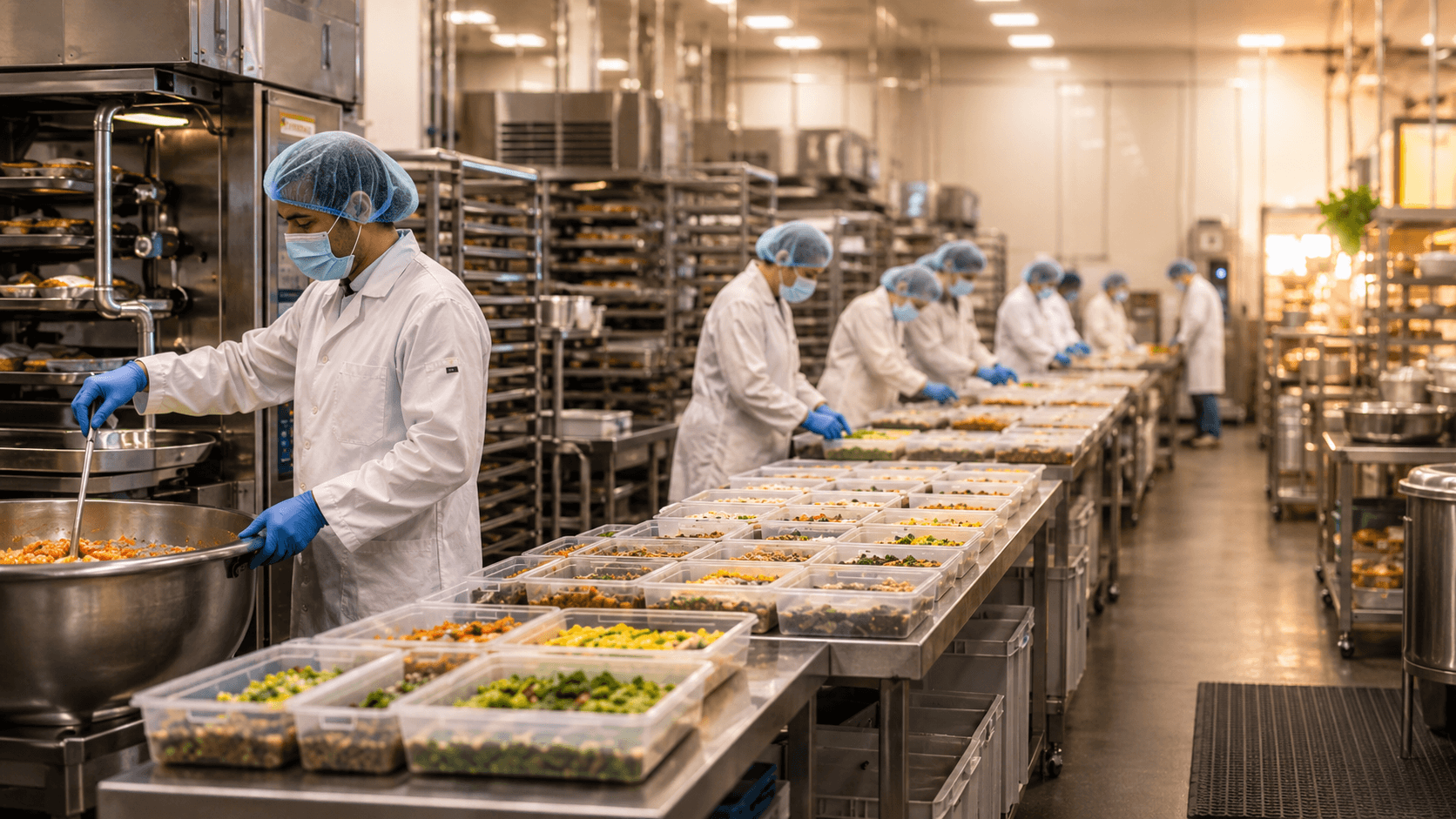
A central production unit is a dedicated commercial kitchen space where the bulk of your food production work happens under one roof. From sauces, marinades and prepped ingredients to cooked proteins and finished dishes. Everything is produced centrally before being distributed to your restaurants, dark kitchens, delivery hubs or catering operations.
While CPUs are often associated with large restaurant groups, you don’t need to be a huge chain to benefit. Plenty of growing SMEs, caterers and delivery brands adopt this model when their kitchen setup can no longer keep pace with demand. Put simply, it allows you to separate making from serving. It sounds obvious, but that shift can have a huge impact on efficiency, consistency and growth.

Bottleneck 1: Duplicated Prep
If you’ve ever stepped into a commercial kitchen early in the morning and found the team already deep into chopping, portioning and prepping sauces before the first order has landed, you’ll know how quickly things can become hectic.
This is the same base task done separately at every site: sauces, stocks, marinades, doughs, chopped veg. Batch prep has economies of scale. Making 40 litres of sauce doesn’t take eight times as long as making five. When five kitchens each make their own five litres, you pay for the set-up, the clean-down and the slow bit five times over. It also keeps your best chef peeling onions, which nobody trained for years to do.
How to price it: tag a fortnight of rota hours spent on shared base prep, estimate how long one team would need for the combined volume (be conservative), and multiply the difference by your loaded hourly cost. That means wage plus employer NICs, pension and holiday, not the rate on the job ad.
Does a CPU fix it? Yes. This is the leak CPUs were invented for. By moving high-volume prep into a dedicated production kitchen, you remove that pressure from your service window completely. Prep becomes a planned efficient process rather than a daily scramble against the clock, done by people whose only job is to do it well.
Bottleneck 2: Cold Storage Overflow
This is the one nobody sees coming and it’s often what limits growth long before kitchen capacity does.
Most smaller kitchens are designed around a walk-in and a few extra fridges. Perfectly fine at 50 covers. At 500 meals a day, it’s a daily game of Tetris, and it costs you three ways: stock binned for date or temperature, emergency top-up orders at a higher price, and storage elsewhere (plus someone fetching from it).
It’s a compliance issue too. In England, chilled food must be kept at 8°C or below, and government guidance is to run fridges at 5°C or below. An overloaded walk-in that can’t hold temperature is a compliance problem before it’s a cost one.
How to price it: add up last month’s binned stock, emergency order surcharges and any off-site storage fees from your waste log and invoices.
Does a CPU fix it? Yes, provided the cold rooms sit next to production. A cold room across town is just another dispatch problem. Dephna has 500+ cold rooms from £400 a month + VAT, so you can add capacity on the same site as your unit as volumes grow. Stop letting fridge space dictate your menu, your ordering and your growth.
Bottleneck 3: Inconsistency (and the Waste It Creates)
Here’s a margin-killer that rarely shows up as a line on the P&L: inconsistency.
It tends to hide behind remakes, customer complaints, giveaways and unnecessary waste.
Nobody’s doing anything wrong, exactly. When the same dish is being produced across multiple kitchens or shifts, variations are almost inevitable. One site’s curry sauce is a bit thicker. Another’s portions run a touch generous. Individually, small differences. Across a week, they add up to fluctuating food costs, disappointed customers and a lot of “that’s not how it normally tastes” feedback.
For delivery brands and dark kitchens, where reviews travel fast and there’s no front-of-house charm to smooth things over, consistency isn’t just important, it’s practically the product.
How to price it: weigh actual yields on your five biggest components for two weeks, compare them with spec, then multiply the average shortfall by your weekly spend on those ingredients.
Does a CPU fix it? Mostly. One recipe, one process, one team, one standard. Here’s how central prep simplifies consistency across every site.
Every multi-site operator eventually has the same realisation: you can’t standardise quality across five kitchens. You standardise it in one CPU and distribute. That’s the entire model.
Nimesh Sachdev, Founder and Chief Excecutive, Dephna
By producing core components centrally, every site starts with exactly the same foundation. Tighter portion control, more predictable yields, and less waste. Instead of each kitchen making its own estimates and adjustments, production is planned against actual demand. That’s good news for operators, protecting both quality and margins.
Bottleneck 4: Time-boxed Production
This is output capped by the clock rather than demand: prep squeezed in before service, booked slots in a shared kitchen, access that stops overnight. It’s the hardest leak to spot because it shows up as sales you never made. The wholesale order you turn down. The catering contract you quoted high and quietly hoped you wouldn’t win.
It also compresses shifts, which means more people working at one, more overtime and less lack when something goes wrong. For SMEs, it tends to land at the worst moment. A big contract, a seasonal peak, a new listing.
The opportunity is there, but production capacity isn’t. If that sounds familiar, you might find value in our guide to scaling production from 500 to 5,000 units a day without compromising quality.
How to price it? Or just capture refused multiplied by contribution per unit plus any overtime or unsocial hours pay used to squeeze work into the window.
Does the CPU fix it? Yes, if you’ve got the keys. Private units with 24 access. 24 hour access means production can run overnight and dispatch can leave before the roads fill.
Bottleneck 5: Dispatch Friction
Five sites ordering separately means five sets of minimum order thresholds, 5 delivery charges and five people signing for crates in the middle of prep. Centralising goods-in should cut that. Whether it does depends almost entirely on where the CPU is.
How to price it? Count supplier drops per site and their charges, total driver or courier hours (including waiting time), and log every late or failed drop for a month.
Does a CPU fix it? Yes, but only in the right location. A CPU in the wrong place just turns 1 cost into another. You save on supplier drops and spend it on vans stuck in traffic. Dephna sites sit close to the A40, the M4 and the North Circular. But check your own drop map against any unit’s location before committing, ours included.
What a CPU Won’t Fix
2 leaks stay stubbornly outside a CPU’s reach. If sites order on gut feel, central production just overproduces faster. And if your menu needs 60 components, a CPU simply makes 60 components centrally. Fix forecasting and menu sprawl first, or you’ll be paying to centralise the problem.
Spotting These Production Bottlenecks Before They Spot You
None of this needs new software. Four weeks and your existing rotas, recipe specs, waste logs and delivery notes will do:
- Week 1: tag shared prep hours on your rotas, start weighing yields and logging late drops.
- Week 2: finish the yield data and compare it with spec.
- Week 3: total bin stocked, surcharges, off-site storage and supplier drop charges, and list every order capped or refused.
- Week 4: add up the five leaks, rank them, and note what a CPU would add in rent, team and transport.
The ranking matters more than the total. In most businesses. One or two leaks account for most of the money, and these should shape your brief size, cold storage, layout and location.. And if the capacity leak hit home, it’s worth knowing how to stand up extra production capacity in weeks before the next big order lands, not after.
When Does a CPU Make Sense for a Growing SME?
There isn’t one magic number, though many businesses find the leaks land somewhere around three to five sites or equivalent volume. Dark kitchens and delivery brands running multiple concepts out of limited space often hit it sooner, because their volume is high even when their footprint is small. The sensible approach is to treat it as a margin decision rather than a prestige one.
On the rent side, Dephna’s private units start from £2000 a month + VAT for around 400 sq ft, on a three-month minimum term. Our breakdown of how much a central production unit costs in London is a good place to sanity-check the numbers. With flexible commercial kitchen space available in London, you don’t have to buy a building or sign up for years to find out.
Final Thought
Production bottlenecks are rarely dramatic. They’re slow leaks: an hour here, a bin of wasted stock there, an order you couldn’t quite take. But they compound, and for a growing business they can quietly turn a strong sales story into a thin-margin one.
The good news is that most are fixable, and you don’t need to rebuild your whole operation to do it.
If you’re starting to feel these bottlenecks in your own kitchen, Dephna offers flexible commercial kitchen and cold storage options across London. All designed for businesses that need room to grow without the long-term commitment.
If it’d help to talk through what a central production setup could look like for you, we’re happy to have that conversation. Get in touch today.
FAQs
What are production bottlenecks in a food business?
Production bottlenecks are points in your process where work slows down or stalls, such as limited prep space, cold storage shortages, or too few skilled hands. They limit how much you can produce and quietly raise your costs.
How do I calculate my loaded hourly labour cost? Start with the hourly rate, then add employer National Insurance (15% on earnings above £5,000 a year), employer pension contributions and holiday pay. The result is what an hour of prep really costs you.
Does a central production unit always save money? No. A CPU saves money when duplicated prep, yield drift, cold storage or kitchen hours are your biggest leaks. It can cost more if its location serves your sites poorly, or if forecasting and menu complexity are the real problem.
What won’t a central production unit fix? Poor forecasting and menu sprawl. A CPU produces what it’s asked for, so bad orders become bad batches at scale, and a 60-component menu stays a 60-component menu.
Do I need to register a central production unit with the council? Yes. Each establishment needs its own food business registration with its local authority, at least 28 days before you start trading from it.
How do I know if cold storage is a bottleneck for my business?
Warning signs include turning away deliveries, ordering in small and frequent batches because of space, overstuffed fridges, and struggling to keep chilled or frozen stock organised and compliant.
When should a growing business consider moving to a CPU model?
Typically when prep is crowding out service, cold storage is capping growth, quality is varying between sites, or you’re hesitating on new orders because production can’t stretch to meet them.
Is London a good location for a central production unit?
For businesses serving customers across the city, yes. A London-based production unit can make distribution to sites, delivery hubs and customers quicker and more efficient.
Sources
- GOV.UK, “National Living Wage increases to £12.71 per hour”, 1 April 2026
- HMRC, “Rates and thresholds for employers 2026 to 2027”
- Food Safety and Hygiene (England) Regulations 2013, Schedule 4
- GOV.UK, “Chilling and freezing” (food hygiene for businesses)
- Food Standards Agency, “Register a food business”
- Dephna rate card, September 2026
Author Information
This article was co-written by…
Raj, Managing Director
Raj is a Managing Director, bringing years of expertise in the food and commercial kitchen rental industry. With a focus on innovation and a deep understanding of business operations, Raj is committed to providing tailored solutions that help food entrepreneurs and start-ups succeed. Outside of work, Raj stays inspired by keeping up with the latest food industry developments.