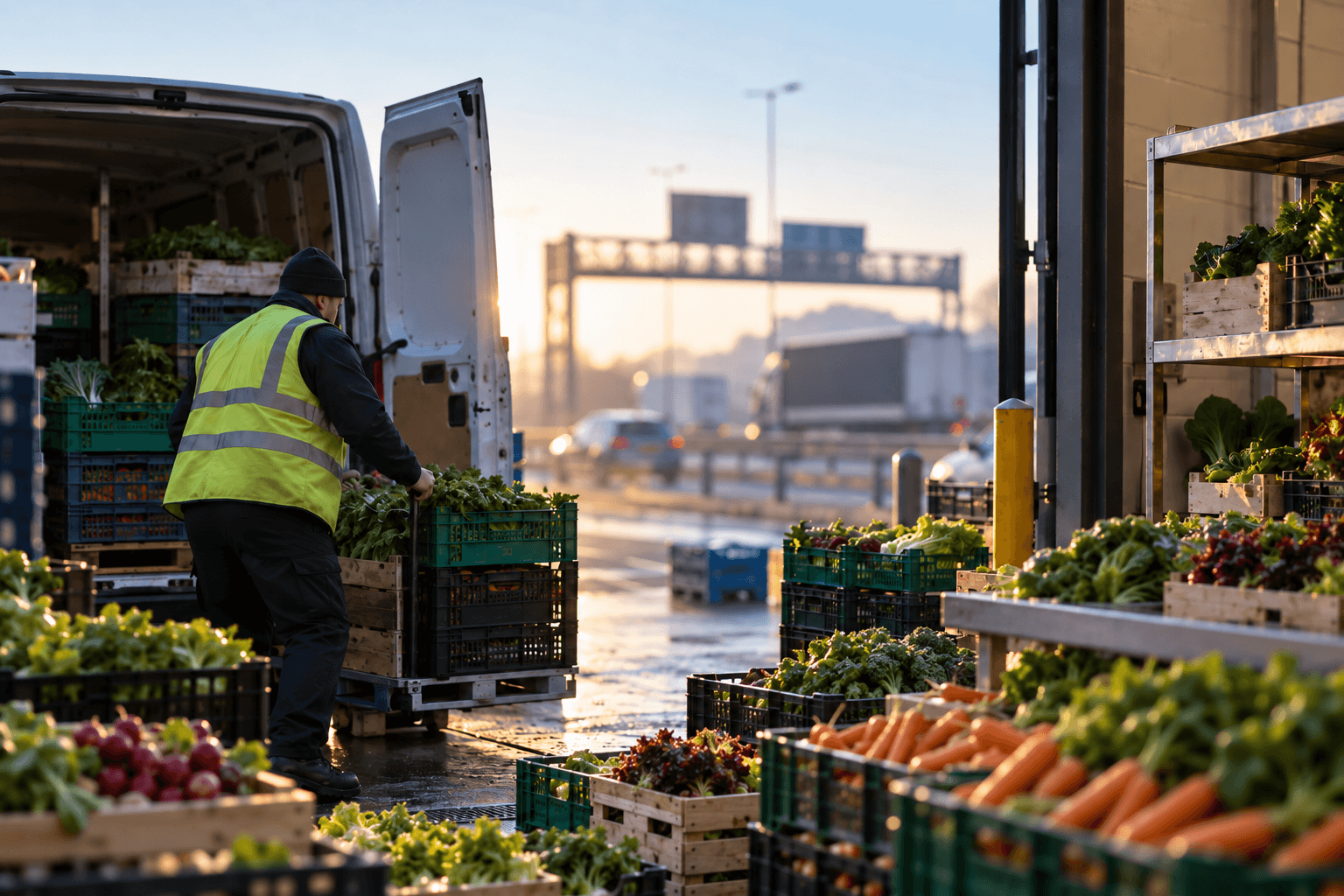

When people talk about how to cut ingredient costs they usually mean cheaper suppliers or bulk buying. But far fewer people talk about what it actually costs to get those ingredients into the kitchen: the haulage, the minimum order sizes, the early-morning drive across town, the spoilage from stock stuck in traffic instead of a chiller. For many London producers, those hidden logistics costs quietly eat more margin than the ingredients themselves.
Where you produce plays a big part in how much of that cost you carry. A kitchen close to London’s main wholesale markets can buy smaller, fresher, and more often, without the delivery premiums or losing hours to transport delays. If you’re trying to trim ingredient spend without sacrificing quality or consistency, proximity to supply is one of the most overlooked levers you’ve got. And it doesn’t have to mean paying central London rent to get it.
The hidden cost of distance
Most food businesses price their ingredients based on a supplier invoice and stop there. But distance from supply adds cost in ways that rarely show up on that invoice directly:
- Delivery minimums and premiums. Suppliers further from your kitchen often require larger minimum orders to make the drop worthwhile. That pushes small and mid-sized producers into buying more stock than they need, more often than they’d like.
- Spoilage in transit. Fresh produce and perishables lose value with every hour spent in a van instead of a chiller. A shorter supply run means fresher stock landing in your kitchen.
- Time cost. When someone on your team spends the morning collecting stock from across the city, that’s time lost from production. It’s a real cost, even if it never appears on a supplier bill.
- Reduced flexibility. Being close to source means you can top up mid-week when a batch runs short, rather than being locked into whatever you ordered days in advance.
None of these show up neatly in a cost-per-unit calculation, but they compound fast, especially for businesses running tight margins on high-volume production.
Where London’s wholesale supply chains actually sit
London’s food supply doesn’t sit in one place. Two of the capital’s principal wholesale markets shape a lot of it. New Covent Garden Market in Nine Elms is the UK’s largest fresh produce market. The Western International Market between Southall and Hayes, one of the country’s biggest fruit, vegetable, and flower wholesale hubs, positioned close to the M4 and Heathrow.
For producers based in west and north-west London, Western International isn’t just a theoretical advantage, it’s a real one. A short run down the A40, M4, or North Circular is far easier than a cross-city trip into the congestion charge zone and back out again. That’s before you even factor in the time, fuel, and driver hours a longer run actually costs.
Park Royal: proximity without the price tag
This is where location choice starts to matter as much as which suppliers you use. Park Royal, one of the UK’s largest industrial estates, sits right at the centre of this corridor. It is no coincidence that it is also one of the country’s biggest food production hubs. The area processes a substantial share of the food consumed in London. Major manufacturers already operate at scale here, drawn by the logistics advantages that make the location work: strong road links, proximity to wholesale supply, and none of the premium attached to a central London postcode.
Our deeper look at why food brands are choosing North West London breaks down the rent differential and transport links in more detail, including what the arrival of HS2 and Old Oak Common could mean for the area in the coming years.
The practical takeaway for producers is straightforward. You get the supply‑chain proximity that once required a central London site without actually being in one. Industrial rents in this corridor are typically well below equivalent space closer to the centre. That difference matters when you are running tight margins on ingredient‑heavy production.
How to cut ingredient costs through proximity alone
Smaller, more frequent orders become viable. When your commercial kitchen is a short drive from wholesale supply, buying little and often stops being a false economy. You’re not padding orders to justify a long delivery run, and you’re not sitting on excess stock that ties up cold storage and risks spoilage before it’s used.
Fresher stock, less waste. Shorter time between purchase and production means less degradation. Vital for perishables where quality and shelf life are directly tied to how long they’ve been in transit.
Faster response to demand spikes. If a batch runs light or an unexpectedly large order comes in, proximity to source means you can top up same-day. No waiting on a scheduled delivery slot days out.
Lower transport overhead per delivery. Shorter runs mean lower fuel costs and less driver time, whether that’s your own team collecting stock or a supplier’s delivery vehicle making the drop.
None of this replaces good supplier negotiation, but it does mean the negotiation isn’t fighting against a structural distance penalty before it even starts. Taken together, these four factors are how proximity alone can cut ingredient costs. All without changing a single supplier relationship.
Choosing a production base with supply chains in mind
If ingredient cost control matters to your margins – and for most food producers, it does – location deserves the same scrutiny as rent and square footage when you’re choosing kitchen space. Worth checking before you commit:
- Road access to major wholesale markets, not just proximity on a map. Actual drive time via the routes you’d realistically use
- Cold storage on-site, sized properly for the stock you’ll be buying more frequently, so proximity to supply translates into genuine flexibility rather than just shorter trips
- Flexible terms, so your production base can scale with you rather than locking you into space sized for today’s volumes
- Realistic transport links for your team, since a site that’s cheap on paper but hard for staff to reach adds its own hidden cost
Our commercial kitchens across North West London are positioned with exactly this in mind. Cold storage sized for producers buying more regularly rather than stockpiling out of necessity. For businesses producing at higher volumes across multiple lines, a dedicated CPU space gives you the room to hold and process stock at scale, without the drive time a more central site would demand. You can see the full spread of sites, and how each one sits relative to the road network, on our locations page.

The mistake that stops businesses cutting ingredient costs at all
The most common mistake we see is producers chasing the cheapest rent without considering what it costs to run a supply chain from that location. A slightly higher rent near good road links and wholesale supply often ends up cheaper overall. A bargain unit that adds an hour to every delivery run rarely stays a bargain for long. It’s worth running the numbers on delivery frequency and transport cost, not just square footage, before signing anywhere. Our pricing reflects the value of that positioning, not just the space itself.
FAQs
Does kitchen location really make a measurable difference to ingredient costs?
Yes, though the effect is easy to miss because it doesn’t show up on a supplier invoice directly. Shorter supply runs mean fresher stock, smaller viable order sizes, and lower transport overhead. Savings that compound significantly over a year of regular ordering.
What’s the closest major wholesale market to North West London producers?
The Western International Market, between Southall and Hayes, is the most accessible principal wholesale market for producers based around Park Royal and the surrounding corridor, reachable via the A40, M4, or North Circular without crossing into central London.
Is Park Royal actually cheaper than central London for a commercial kitchen?
Considerably, in most cases. Industrial rents in Park Royal and the surrounding North West London corridor typically sit well below equivalent space closer to the centre, while still offering strong road and transport links.
Do I need my own vehicle to benefit from proximity to wholesale markets?
Not necessarily. Many wholesalers deliver, and shorter delivery routes still translate into lower costs and fresher stock even when you’re not collecting yourself. Proximity helps whether you’re driving to source or having it delivered to you.
How much cold storage do I need if I’m buying more frequently?
Less than you might expect, since the whole benefit of proximity is not needing to hold as much stock at once. That said, having cold storage sized correctly still matters for managing the stock you do hold safely and efficiently.
Will HS2 and Old Oak Common change logistics in this part of London?
It’s expected to, over time. Old Oak Common is set to become a major transport hub within the Park Royal corridor, which is likely to improve connections further for businesses already based in the area.
Is proximity to wholesale markets more important for some types of food business than others?
Yes! It matters most for businesses handling fresh, perishable ingredients at volume, such as those producing sauces, ready meals, or bakery items. Businesses working mainly with shelf-stable ingredients will see a smaller effect, though transport cost still applies.
What’s the fastest way to cut ingredient costs without switching suppliers?
Moving production closer to your main wholesale supply is often the single biggest lever available without renegotiating a single contract. It shrinks delivery premiums, cuts spoilage, and makes smaller, more frequent orders viable. Savings that stack up before any supplier conversation even happens.
Thinking about where your next kitchen should sit, not just how big it should be? Get in touch with Dephna to talk through commercial kitchen and cold storage space positioned for the supply chains you actually rely on.
Author Information
This article was co-written by…
Brindha, Sales Director
Our Sales Director, Brindha, knows her stuff when it comes to finding the perfect commercial kitchen or cold storage solution. With years of experience and a hands-on approach, she’s all about making life easier for food entrepreneurs so they can focus on what they do best – creating amazing dishes. When she’s not helping businesses thrive, Brindha’s out and about exploring the hottest food trends around London.


