
Open a second site and you inherit a second kitchen team, a second set of hands measuring “a pinch of salt,” and a second set of small decisions nobody wrote down. Open a fifth, and those small decisions have multiplied into something your customers can actually taste. This is the hard part. Nobody puts consistency at scale on the investor deck: maintaining consistent quality doesn’t get easier as you grow. It gets harder, one site at a time.
Central prep is how the operators who scale smoothly solve this – not by hiring more chefs and hoping training closes the gap, but by removing the variable entirely. Here’s how it actually simplifies operations across every site, and what to move centrally versus what stays local.
Why Consistency of Scale Breaks Before Anything Else Does
Customers don’t experience a restaurant group as one brand. They experience it as whichever branch happens to be closest to them, and if that branch’s version of a signature dish tastes different from the one across town, that reads as a brand failure – not a training gap you can fix with another induction session.
The uncomfortable truth is that this isn’t a people problem. Every kitchen team, however skilled, introduces small variations: slightly different yields, slightly different timing, a slightly different interpretation of a method that was only ever demonstrated once. At one site, that variation is invisible. At five or ten sites, it compounds into a genuinely inconsistent product – and it’s usually discovered by a customer, or a review, long before it shows up in a spreadsheet.
What Central Prep Actually Means
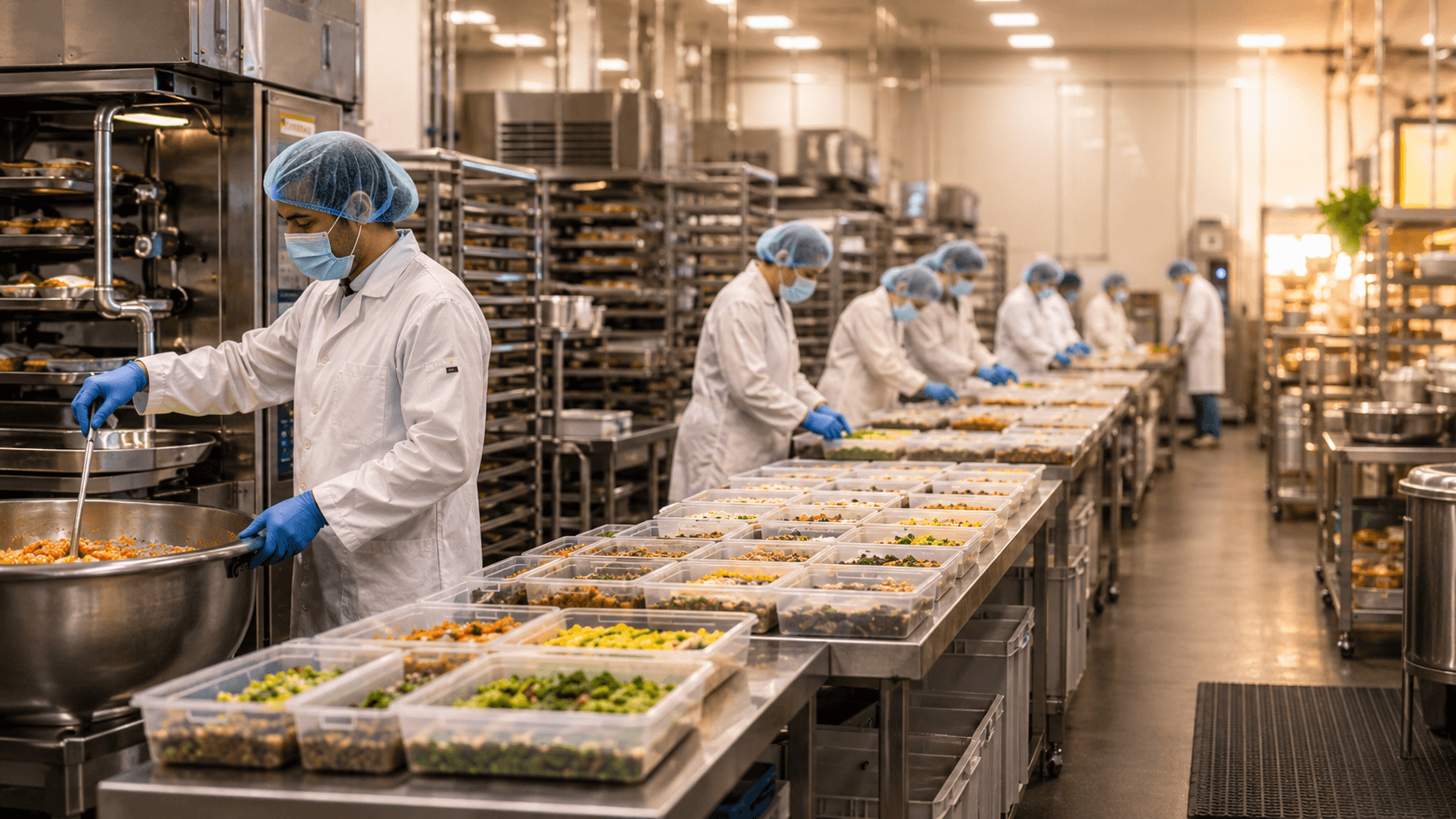
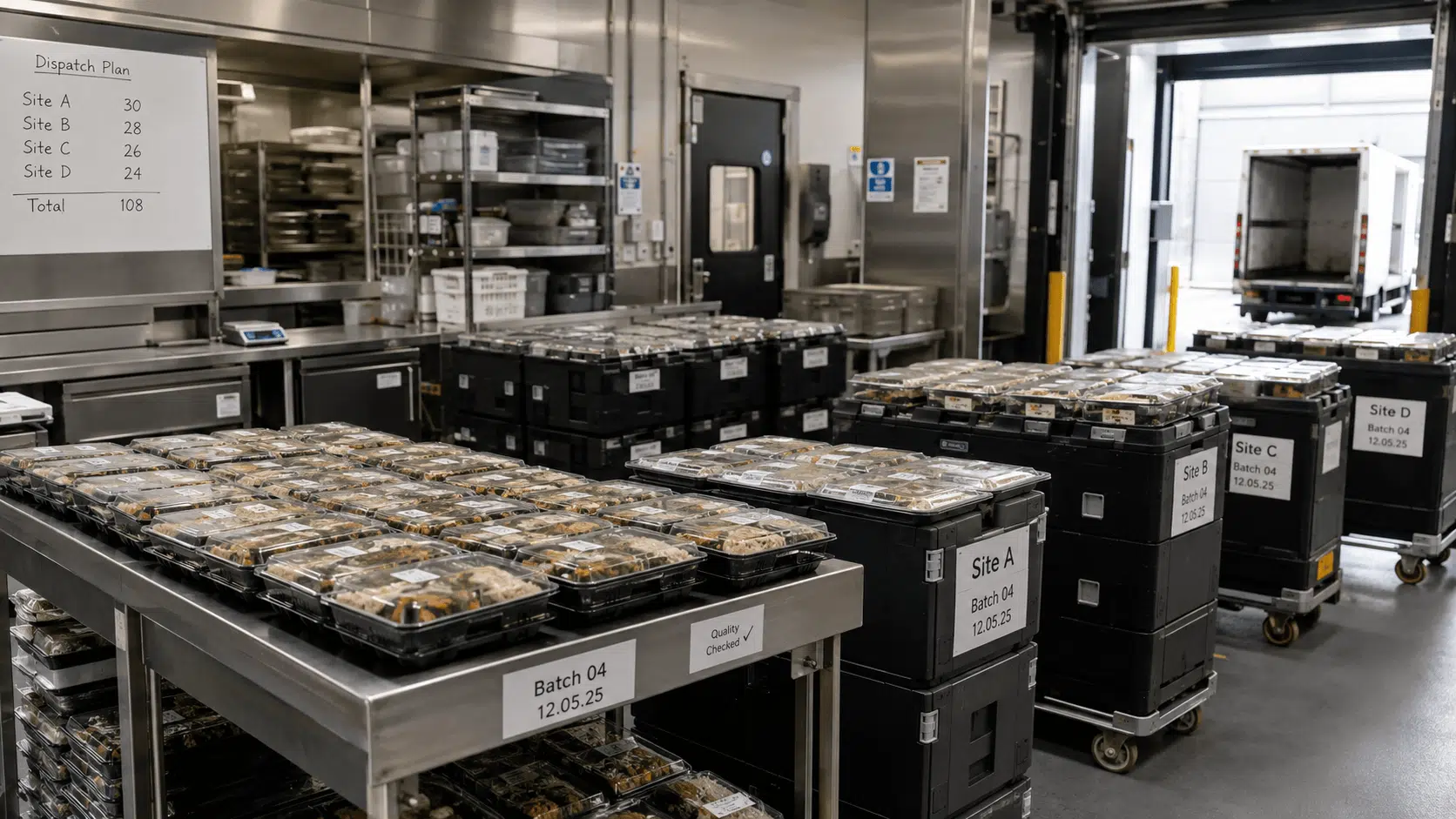
Central prep – sometimes called a central production unit, central kitchen, or commissary kitchen – moves core production away from individual sites and into one dedicated facility. Base components, sauces, marinades, and batch-cooked elements get made in exactly the same place, by exactly the same team, to exactly the same process, every time. Individual sites then finish, plate, and serve, rather than each one running its own full production line from scratch.
It’s not an all-or-nothing model. Most groups centralise the components that carry the most consistency risk – sauces, dressings, marinades, batch-cooked bases – while leaving finishing and plating to individual site teams, who are usually better placed to handle real-time service anyway.
How Central Prep Simplifies Each Type of Site
Dine-in restaurants. Front-of-house teams stop absorbing production complexity they were never built to manage. On-site kitchens focus on finishing and plating to order, while the components most prone to drift – the ones that take skill and repetition to get exactly right – come in ready and consistent.
Delivery and dark kitchens. Speed matters more than almost anything else in delivery, and a dark kitchen juggling full production alongside packing and dispatch under time pressure is where corners get cut fastest. Central prep removes a layer of that pressure, letting delivery kitchens focus on assembly, packing, and getting orders out the door quickly.
Catering operations. Catering runs on unpredictable volume – quiet weeks followed by an event needing five times the usual output. Central prep absorbs that variability far better than expecting a single site to scale production up and down on short notice.
Franchise and licensed sites. This is where consistency risk is highest, since franchise partners are running your brand without your direct oversight. Centrally produced components mean the thing most likely to vary – recipe execution – is controlled at source, regardless of who’s running the site day to day.
What Moves Centrally, and What Stays On-site to Maintain Consistency At Scale
A useful rule of thumb: centralise anything where variation is high-risk and repetition rewards a dedicated team; keep anything time-sensitive or personalisation-dependent on-site.
- Move centrally: sauces, dressings, marinades, dough, batch-cooked bases, portioned proteins, anything requiring skilled technique that’s hard to standardise across multiple teams
- Keep on-site: final cooking, plating, garnishing, anything that needs to be fresh to order or customised per customer
Getting this split right is as much a strategic decision as an operational one – move too much centrally and you lose the flexibility individual sites need for genuine customisation; move too little and you haven’t actually solved the consistency problem you set out to fix.
The Infrastructure Central Prep Actually Needs
Central prep only works if the facility behind it is built for the job. That means a space designed around central production units specifically – dedicated zones for prep, batch cooking, cooling, and packing – rather than a standard site kitchen stretched to cover a role it was never designed for.
Two things matter more than anything else once you’re producing for multiple sites:
- Cold storage sized for distribution, not just daily prep. Batch-produced components need to be held safely and consistently ahead of delivery to each site – undersized cold storage is one of the most common reasons central prep models underdeliver on the consistency they’re supposed to guarantee.
- A location that actually works for your distribution network. A central kitchen only simplifies operations if it can get product to every site reliably. Reviewing locations against your existing and planned sites is worth doing before committing to space, not after.
According to one industry analysis of multi-site hospitality operations, centralising sauce and component production is exactly how chains like Wagamama maintain identical flavour and quality across every branch nationally – proof that this isn’t a theoretical model, it’s how established groups already operate at scale.
What It Costs To Get This Wrong
Groups that skip central prep and try to scale on training alone tend to hit the same wall repeatedly: a new site opens, performs well for a few months while the founding team is heavily involved, then drifts once day-to-day running passes to a site manager and local hires. Each new opening resets the clock instead of building on what already works. Central prep breaks that cycle – new sites plug into existing recipes, processes, and supply chains rather than starting from zero, which is also why groups using this model tend to open new sites faster with less risk.
Getting the Model Right From Day One
The groups that get the most out of central prep are the ones who design for it before they need it – choosing a facility and provider who understands the specific demands of multi-site restaurant production, not a generic industrial unit repurposed for food. The right space, set up properly from the start, saves you from outgrowing it within eighteen months and having to relocate mid-scale. Our guide on what a central production unit does for a 5+ site restaurant group goes deeper into exactly this, including where the model tends to pay off fastest. For groups still weighing up whether to centralise, our comparison of CPUs versus restaurant kitchens is a useful next read on how the decision plays out in practice, and understanding pricing at this stage helps you plan the move without surprises down the line.
Scaling across multiple sites and want consistency built in from the start? Get in touch with Dephna to talk through the right central production unit or cold storage setup for your restaurant group.
FAQs
How many sites do I need before central prep makes sense? There’s no fixed threshold, but most groups start feeling the pressure around three to five sites, once informal training and site-to-site communication stop being enough to hold quality consistent. Some groups centralise earlier if consistency is core to their brand from day one.
Does central prep mean I lose flexibility at individual sites? Not if it’s set up well. Most groups centralise high-risk components like sauces and bases while leaving finishing, plating, and customisation to site teams, which preserves flexibility exactly where customers notice it most.
What’s the difference between a central production unit and a dark kitchen? A dark kitchen is built for delivery-only service – cooking, packing, and dispatching orders in real time. A central production unit is built for batch production and distribution to multiple sites, including dine-in restaurants, delivery kitchens, and franchise locations.
Is central prep only worth it for large restaurant chains? No. Many small and mid-sized groups use central prep to scale gradually rather than needing full manufacturing volume from day one. Starting with flexible space and centralising a small number of high-risk components is a common, lower-risk starting point.
How does cold storage affect a central prep model? It’s often the main practical constraint. Proper cold storage lets you batch produce further ahead of need and hold stock safely for distribution – without it, central prep can’t actually deliver the consistency it’s meant to provide.
Can central prep help when opening new sites, not just running existing ones? Yes, often significantly. New sites can plug into existing recipes, supply chains, and processes instead of building everything from scratch, which typically makes new openings faster and considerably lower-risk.
Does every dish need to come from central production? No. Most groups centralise base components – sauces, marinades, batch-cooked elements – while leaving final cooking, plating, and finishing to individual sites, where real-time service still matters most.
Author Information
This article was co-written by…
Brindha, Sales Director
Our Sales Director, Brindha, knows her stuff when it comes to finding the perfect commercial kitchen or cold storage solution. With years of experience and a hands-on approach, she’s all about making life easier for food entrepreneurs so they can focus on what they do best – creating amazing dishes. When she’s not helping businesses thrive, Brindha’s out and about exploring the hottest food trends around London.