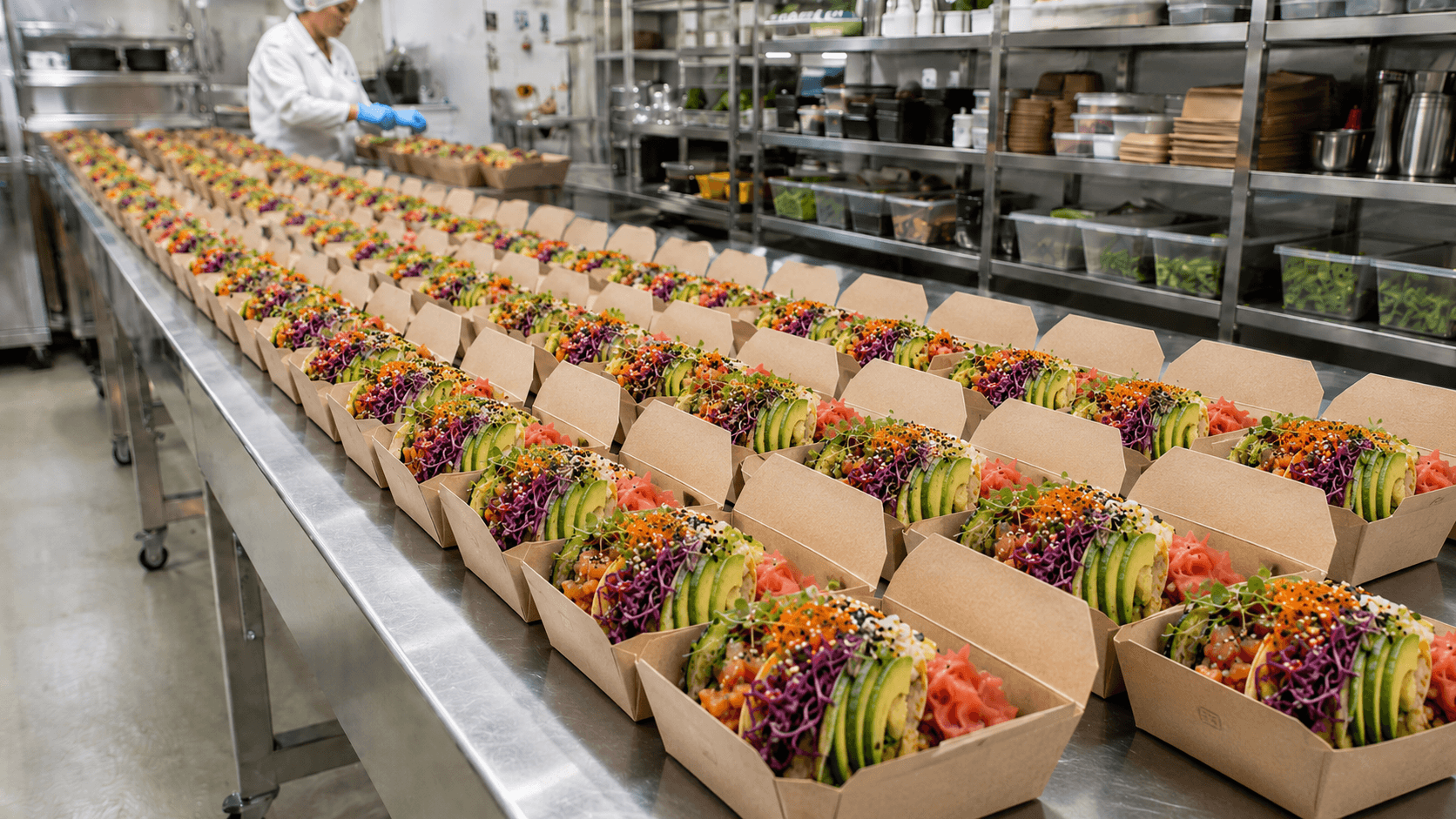

Every food business we’ve worked with over the last decade has hit a version of the same moment: an order lands that’s significantly bigger than anything the team has fulfilled before.
It’s exactly the opportunity you’ve been working towards. But it’s also where weaknesses that were manageable at lower volumes suddenly become expensive.
Going from 500 units a day to 5,000 isn’t simply a question of buying more ingredients and asking the team to work faster. Production times change. More people touch each product. Stock stays on site for longer. Packing becomes a bigger operation. Suppliers have to deliver more reliably. A delay at one stage can quickly affect everything behind it.
The businesses that handle the jump well don’t try to multiply their existing process by ten. They work out what needs to change before the bigger volume arrives.
Here’s how to approach scaling food production without allowing consistency, margin or operational control to disappear along the way.
Start With Your Real Production Capacity
“We don’t sell kitchens. We sell the certainty that your production won’t be the thing that stops your business growing.”
Nimesh Sachdev, Founder, Dephna
Before committing to 5,000 units, you need to know what your kitchen can actually produce comfortably.
That means looking beyond your theoretical maximum output.
Track a normal production day and identify:
- how long each production stage takes
- where products spend time waiting
- which pieces of equipment are continually in use
- how much time is lost between batches or products
- where staff regularly wait for space, ingredients or equipment
- how long portioning and packing take compared with cooking
- whether cold storage, dry storage or dispatch space is already close to capacity
The slowest part of the operation is normally more important than the fastest. If you can cook enough product for 5,000 units but can only pack 3,000 within your available shift, you have a 3,000-unit production system.
Increasing output therefore starts with finding and removing bottlenecks rather than simply increasing batch sizes.
Don’t Jump Straight From 500 to 5,000
If you have the opportunity, ramp production in stages.
A business producing 500 units might test 1,000 or 1,500 first, then move towards 3,000 before attempting the full 5,000-unit day.
Each stage gives you an opportunity to find problems under controlled conditions.
Ask:
What happened to production time? A process that takes one hour at low volume doesn’t necessarily take two hours at double the volume. Equipment capacity, loading time and cleaning can change the relationship.
Where did queues develop? Watch ingredients, people and finished products as they move through the kitchen. Waiting is often an early sign that one area isn’t sized correctly for the new volume.
Did waste increase? Higher waste can indicate that portion control, batch sizing or handling methods are becoming less consistent.
Did the finished product remain within specification? Check weight, appearance, texture, packaging and any other product-specific requirements.
A staged ramp means you’re solving problems while they’re still relatively small rather than discovering them halfway through your biggest order.
Lock Down the Product Specification Before Increasing Volume
At 500 units, an experienced team member might instinctively know what the finished product should look and feel like.
That becomes much harder when several people are working across different stations or shifts.
Before increasing output, define what an acceptable unit actually is.
Depending on the product, your specification might include:
- portion or fill weight
- dimensions
- appearance
- ingredient quantities
- cooking or preparation parameters
- cooling and storage requirements
- packaging format
- label placement
- acceptable tolerances
This isn’t about removing craftsmanship. It’s about making sure everyone is working towards the same result.
If one person’s idea of the correct portion is slightly different from another’s, that difference becomes much more visible across thousands of units.
Increase Quality Checks As Production Becomes More Complex
Checking the finished product at the end of a 500-unit run may once have been enough to spot obvious problems.
At 5,000 units, discovering an issue at the end of the day could mean hundreds or thousands of affected products.
Build checks into the production run instead.
That could mean checking the first units from a batch, sampling at agreed intervals, recording results and having a clear procedure for what happens when something falls outside specification.
You should also be able to identify:
- which batch a finished unit came from
- which ingredients were used
- when it was produced
- which checks were completed
- what corrective action was taken if something went wrong
Your food safety management system should grow with the complexity of your operation too. The government’s HACCP guidance sets out the principles food businesses need to consider when identifying hazards, critical control points, monitoring requirements and record keeping.
Design Production Around Handovers, not Individual People
At smaller volumes, one experienced person can often oversee most of a production run.
As output grows, you may need more staff, longer production windows or additional shifts.
That introduces another risk: information getting lost between people.
A good handover should make it immediately clear:
- what has already been produced
- what is currently in progress
- what still needs to be completed
- whether any batches have been placed on hold
- whether stock or ingredients are running low
- whether equipment or production issues have occurred
The objective is simple: the quality of the next 1,000 units shouldn’t depend on whether the person who made the previous 1,000 is still in the building.
Stress-test Suppliers Before You Need Ten Times the Ingredients
Your production capacity isn’t the only thing that needs to scale.
If a supplier reliably delivers enough ingredients for 500 units, don’t automatically assume they’ll be able to supply ten times as much at the same notice.
Speak to key suppliers before confirming larger contracts and understand:
- their maximum reliable volumes
- required lead times
- minimum order quantities
- delivery frequency
- what happens if an ingredient is unavailable
- whether specification remains identical at larger volumes
Do the same with packaging suppliers.
A shortage of trays, lids, labels or outer cases can stop production just as effectively as running out of ingredients.
Where one material is business-critical, having an approved alternative supplier or agreed contingency can make a significant difference.
Make Sure Storage Grows Before Production Does
Larger production runs mean more incoming ingredients, packaging, work in progress and finished goods on site at the same time.
Storage therefore becomes a capacity issue surprisingly quickly.
This is especially important for chilled and frozen products. Trying to fit significantly higher volumes into storage designed for a smaller operation can make stock management harder and reduce the usable capacity of the kitchen.
If your existing operation is already tight, additional cold storage can be added alongside production space rather than forcing the kitchen itself to absorb everything.
Think about the entire stock journey: incoming ingredients, production, finished stock and dispatch. Each stage needs enough capacity for the volume you’re planning to handle.
Reconfigure the Kitchen Around the New Bottleneck
At 500 units, a compact layout can be an advantage.
At 5,000, the same layout might mean people continually crossing paths, packaging accumulating next to production areas or completed batches waiting for the next available workstation.
You may need more room between production stages rather than simply more cooking capacity.
That could mean dedicated areas for preparation, production, cooling, packing, storage and dispatch, depending on the operation.
Choosing flexible commercial kitchens can make this easier because the space can be configured around the way your business actually works.
For higher-volume production businesses, a central production unit may provide the additional production and storage footprint required. Delivery-first businesses may instead need scalable dark kitchen or delivery kitchen space.

The important point is to let your production process determine the space, rather than forcing a growing process into a layout that has already reached its limits.
If you’re currently operating from shared facilities, our guide to private kitchens vs shared kitchens can also help you decide whether dedicated space has become the more practical option.
Work Out What the Bigger Order Actually Costs
A tenfold increase in units doesn’t necessarily produce a tenfold increase in profit.
Before taking on a significant order, model what changes.
Look beyond ingredients and include:
- additional labour
- overtime or extra shifts
- packaging
- increased storage requirements
- utilities
- additional cleaning
- delivery and distribution
- increased waste during the ramp-up
- additional equipment or kitchen space
- working capital required before the customer pays
Some costs become more efficient as you scale. Others appear for the first time.
Understanding the full cost per unit at the new volume makes it much easier to tell whether the contract is genuinely profitable.
You can view Dephna’s current commercial kitchen pricing when building space costs into your production forecast.
Don’t Forget the Last 20 Metres of Production
Businesses often spend most of their scaling effort on making more food.
But those extra units still need to be labelled, packed, stored, picked up and dispatched.
Before your first full-volume run, test what happens at the end of the production line.
Can completed orders move through the space without blocking production? Is there enough room for pallets, cases or delivery cages? Can vehicles load efficiently? Can multiple collections happen without finished stock sitting where the next batch needs to go?
At volume, a poorly designed dispatch process can create delays even when everything inside the kitchen has run perfectly.
This is also where location becomes increasingly important. Being close to customers, suppliers and major transport routes can reduce unnecessary mileage and simplify daily logistics. Dephna has commercial kitchen locations across North-West London, allowing businesses to choose a base that works for their production and distribution needs.
Run a Full-Volume Rehearsal
Where possible, don’t make your first 5,000-unit production day the day a major customer is expecting 5,000 units.
Run a rehearsal.
You don’t necessarily need to produce the entire order, but the test should put each part of your process under realistic pressure.
Measure:
- output by hour
- downtime
- changeover time
- rejected or reworked units
- ingredient usage
- packaging usage
- staffing requirements
- storage utilisation
- packing speed
- dispatch time
Then compare what actually happened with the assumptions behind your production plan.
The difference between the two tells you what still needs fixing.
Your 5,000-unit Go/no-go Check
Before accepting a major jump in volume, you should be comfortable answering yes to the following:
- Can every production stage handle the required daily volume?
- Have you tested the process above your normal output?
- Are product specifications documented?
- Are checks taking place throughout production?
- Can different team members produce the same result?
- Can suppliers reliably meet the increased demand?
- Is there enough storage for ingredients and finished products?
- Can packing and dispatch keep pace with production?
- Have you calculated the true cost of the new volume?
- Do you have a contingency if equipment, supply or staffing problems occur?
If several answers are still “not quite”, solving those problems before the order arrives is usually much cheaper than solving them while the production clock is running.
The Takeaway
Scaling from 500 units to 5,000 isn’t primarily about making your team work ten times harder.
It’s about removing the need for them to.
Measure your actual capacity, find the bottlenecks, test higher volumes gradually and make specifications, quality checks and handovers repeatable. Then make sure your suppliers, storage, packing, space and distribution can handle the same volume as your production line.
Do that before the bigger order arrives and 5,000 units becomes a planned production day rather than an operational emergency.
Planning your next stage of growth? Get in touch with Dephna to talk through the right commercial kitchen, cold storage, or central production unit for where your business is heading, not just where it is today.
FAQs
How long does it typically take to scale from 500 to 5,000 units a day? It varies by product and process, but most businesses we work with take six to twelve months to scale that tenfold, and the ones who move fastest are usually the ones who standardise their process and secure the right space before volume forces their hand, not after.
What’s the biggest cause of quality problems when scaling production? Process, not ingredients or recipe. At low volume, one experienced person can maintain consistency through attention alone. At high volume, quality depends on documented, repeatable steps that any trained team member can follow the same way – without that documentation, consistency breaks down as soon as more people or shifts are involved.
Do I need a central production unit to scale, or can I stay in a standard commercial kitchen? It depends on your volume and complexity. A well-laid-out commercial kitchen can handle significant growth, but once you’re supplying multiple sites or need dedicated zones for each stage of production, a central production unit typically gives you the process separation and consistency that a general-purpose kitchen can’t.
How much cold storage do I need once I’m producing at higher volumes? More than most businesses estimate. At low volume, you’re often producing close to what you sell same-day. At higher volumes, you’re holding meaningful stock ahead of delivery schedules, so cold storage needs to be sized for stock holding, not just daily production turnover.
When should I move from a shared kitchen to a private one? Generally once shared time slots, equipment access, or storage limits start capping your output, or when you need guaranteed access to hit delivery deadlines reliably. Businesses that move before they’re forced into it by a missed order tend to scale more smoothly than those who wait until capacity runs out.
Does scaling production always mean higher costs per unit? Not necessarily, but costs rarely scale in a straight line with volume either. Utilities, staffing hours, and cold storage costs typically increase in steps rather than smoothly, so it’s worth mapping your cost curve at each stage of growth rather than assuming a bigger order automatically means a proportionally bigger margin.
How important is HACCP documentation when scaling up? Very. A HACCP-based food safety management system that reflects your actual process is what lets quality checks stay consistent as more staff and shifts get involved. Retrofitting proper documentation after you’ve already scaled is far harder than building it in before volume increases.
Can I scale production without changing my kitchen location? Sometimes, if your current site has room to grow into. But location constraints – loading access, transport links, and proximity to your customer base — tend to matter more at high volume than at low volume, so it’s worth checking your site can support 5,000 units a day, not just 500, before you commit to staying put.
How do I increase food production without losing quality? Standardise your process before you scale it – written procedures, defined quality checkpoints, and HACCP-based documentation that doesn’t depend on one experienced person’s judgement. Pair that with a facility sized for where you’re heading, not just where you are, and quality holds as volume climbs rather than eroding along the way.
Author Information
This article was co-written by…
Nimesh, Managing Director
Our Managing Director, Nimesh, is a seasoned expert in entrepreneurship, business strategy and real estate development, with a strong focus on the food and commercial kitchen rental industry. He’s passionate about empowering businesses and start-ups by creating flexible, high-quality spaces that help them thrive. When he’s not driving the business forward, Nimesh is busy exploring the newest food spots to stay ahead of the game.


